
In early August 2026, Anastasia Kourou noticed queries in her Search Console that did not look like searches: “yes”, “yes go on”, “yes, pricing”. She posted it on LinkedIn and asked John Mueller whether Search Console was recording what people say to the AI. Mueller replied that this data had always been in the Performance report and linked to Google’s documentation.
Since then, Glenn Gabe, Suganthan Mohanadasan and Jean-Christophe Chouinard have published ways to find and classify these queries, all with English-language data. This study does the same in Spanish and adds a time dimension: 16 months of data from 27 Spanish properties across very different sectors.
It answers four questions:
- What kinds of conversational queries show up in Search Console?
- When did they start, and how do they relate to Google’s product changes?
- How much do they weigh, and what clicks do they bring?
- What can you do with them in an SEO project?
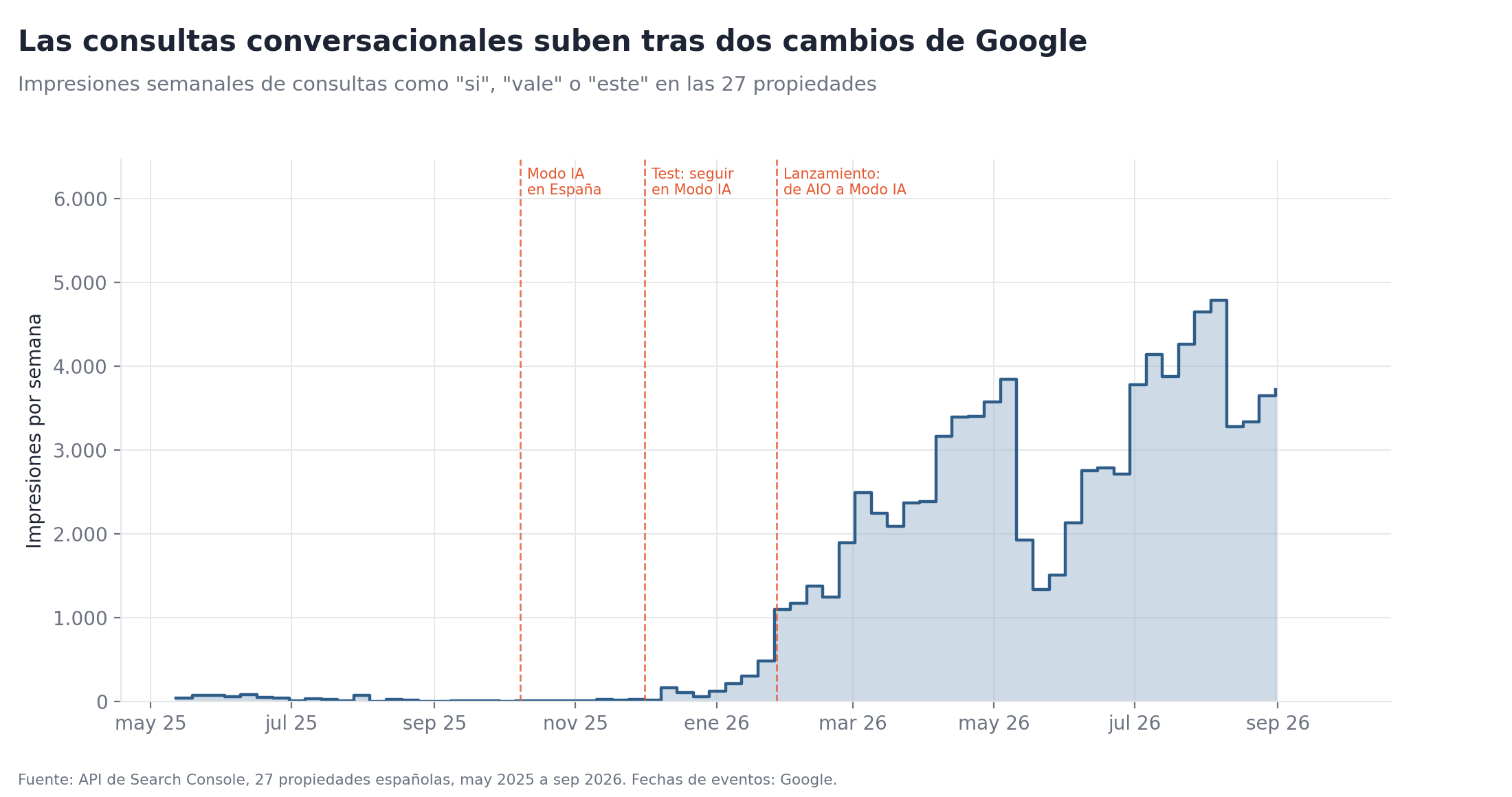
The short answer: they appear from December 2025, almost all of them are the word “si” (yes), and they become established in January 2026, when Google makes follow-up questions in AI Overviews open in AI Mode. They account for about three impressions in every hundred thousand. And much of what a simple filter flags as conversational is actually brands and products.
The queries in this study are in Spanish. Each example includes an English translation in brackets. This is the English version of an article originally published in Spanish.
The study in one minute
- Conversations with Google’s AI leave a trace in Search Console. Every user reply (“si” [yes], “vale” [ok], “y este” [and this one]) is recorded as a separate query.
- They appear in every property analysed, whatever the sector.
- They grow with Google’s product changes, not with the AI Mode launch. The jumps come with the December 2025 test and the January 2026 launch that takes users from AI Overviews into AI Mode.
- Almost all of it is “si” (yes). It is the reply to the invitations that close three in ten AI Overviews.
- They weigh little but bring clicks. Three impressions per hundred thousand, with a CTR twice the properties’ average.
- They tell you what your content was missing. The conditions users add in a second turn (“y precio” [and price], “y online” [and online]) are keyword research written by your own users.
- Measuring it takes a lot of cleaning. In Spanish, most of what a simple filter captures is brands and products.
| The study in numbers | |
|---|---|
| Properties | 27 Spanish sites from different sectors |
| Period | May 2025 to September 2026 |
| Total traffic analysed | 2.909 billion impressions |
| Conversational queries after cleaning | 131,863 impressions |
| Weight over total | 3.3 impressions per 100,000 |
Why it shows up in Search Console
Every turn in an AI Mode conversation counts as a new query. Google’s documentation on impressions, position and clicks says so in its AI Mode section: when a user asks a follow-up question, the impressions, position and clicks of the new response are attributed to that new query.
If someone reads a response and replies “sí, por favor” (yes, please), Google generates another response with its own links. If your page appears in it, Search Console records an impression for the query “sí, por favor”.
How can there be clicks if the user keeps talking?
Because continuing the conversation and clicking are not mutually exclusive. The same documentation says that, in AI Mode, clicking a link to an external page counts as a click. The sequence is:
- The user types “si” (yes).
- Google answers with new text that includes links.
- If the user clicks the link to your page in that response, the click is attributed to the query “si”.
What stays inside Google does not count as a click: tapping a suggestion, opening another search or asking another question. Google treats those as query refinements and records no click.
Two more points from the documentation worth keeping in mind:
- Position is not a ranking. In AI Mode it is calculated with the same rules as a results page. A “si” in position 4 tells you where your link sat inside the response.
- Surfaces are not separated. Search Console mixes classic results, AI Overviews and AI Mode in the same report. A “si” could also be typed into the regular search box. The method detects the pattern, not the surface.
How I measured it
27 Spanish properties from different sectors, 16 months of data (the maximum Search Console keeps) and API exports from R. The interface caps exports at a thousand rows and is no use for this.
Three exports, each with its own job
Search Console totals never match across different API calls, because each combination of dimensions filters and anonymises data differently. So every figure is calculated from the export that fits it.
| Export | What I use it for |
|---|---|
| Query + page | Classifying queries and seeing which page appeared in the response |
| Query + date, for conversational queries only | Dates, trends and clicks |
| Daily totals per property | Weight over total and baseline CTR |
Cleaning is half the work
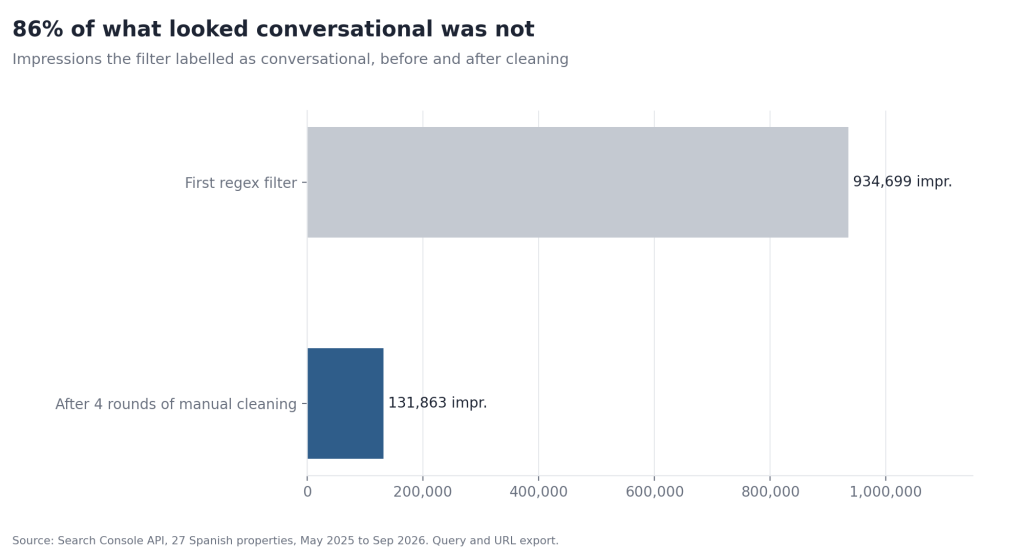
A filter looking for “si” (yes), “no”, “más” (more) or “dime” (tell me) returns a lot, but in Spanish these are everyday words that collide with brands and products. If you don’t review the highest-volume queries by hand, you end up measuring brands and broken appliances.
| What the filter caught | What it really was |
|---|---|
| “dime” | a skateboarding clothing brand |
| “y 3” | a designer’s fashion line |
| “no problemo”, “dame 9” | trainer models |
| “vale rossi” | a motorcycle racer |
| “calcula tu irpf” | a tax calculator on the site itself |
| “segunda mano valencia” | “no vale” hidden in “maNO VALEncia” |
| “másteres universitarios” | “eres un” hidden in “mastERES UNiversitarios” |
| “touchpad no funciona” | a broken device, not a complaint to the search engine |
| “🪬 significado” | a search for what an emoji means |
Four rounds of manual review brought the volume down from 934,699 to 131,863 impressions.
To date and measure the trend I only use queries that cannot be confused with a normal search: “si”, “sí” (yes), “vale” (ok), “ok”, “este” (this one), “otra” (another), “si por favor” (yes please) and similar, 38 in total. I call them topic-free conversational queries.
How I date the start
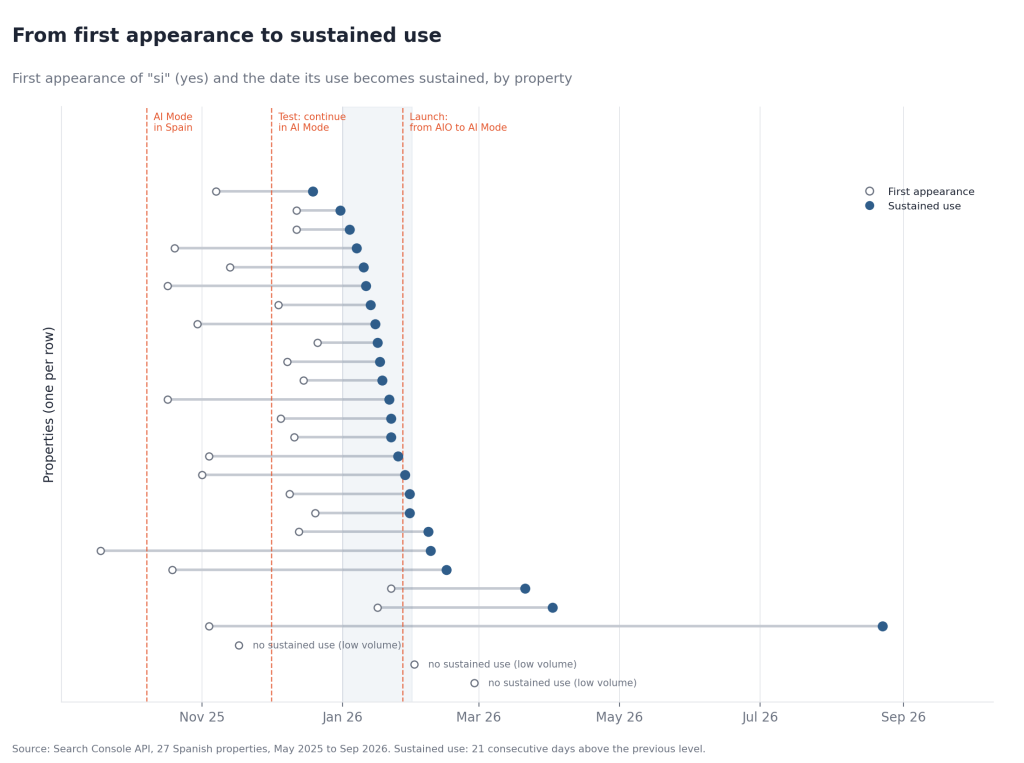
The first appearance of “si” in a property is not a valid start date, because there is always some noise. I look for the day from which use is sustained: the 14-day average exceeds the previous level and stays above it for 21 consecutive days.
Two checks:
- Control. I applied the same method to nine normal queries with stable traffic. Eight show no change and the ninth is seasonal (motorcycle gloves in November).
- Parameters. Across nine combinations of window and duration, the median date only moves between 20 and 25 January 2026.
Types of conversational queries
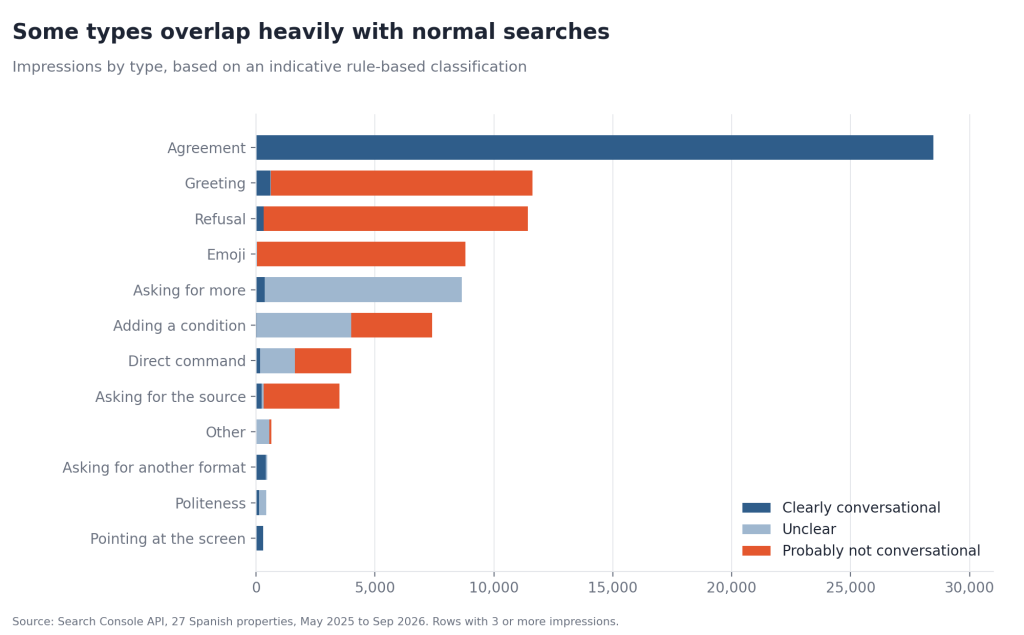
The queries fall into fifteen types, but only three are reliable after manual review: agreement, pointing at something on screen and asking for another format. The rest overlap heavily with normal searches.
| Type | Examples | Impressions | Reliability |
|---|---|---|---|
| Agreement | “si”, “sí” (yes), “vale”, “ok”, “claro” (sure) | 47,916 | high |
| Refusal | “no”, “no gracias” (no thanks) | 13,479 | unclear |
| Asking for more | “otra” (another), “otros” (others), “más opciones” (more options), “repite” (repeat) | 13,200 | unclear |
| Greeting | “hola” (hello), “buenas” (hi) | 12,411 | unclear |
| Direct command | “explícame” (explain), “muéstrame imágenes” (show me images) | 12,338 | unclear |
| Adding a condition | “y precio” (and price), “y online” (and online), “pero fruta” (but fruit) | 10,946 | medium |
| Emoji | “si por favor 🙏” | 9,137 | unclear |
| Asking for the source | “fuente” (source), “enlace” (link) | 5,182 | unclear |
| Pointing at the screen | “este” (this one), “esta”, “y este” (and this one), “ambos” (both) | 2,949 | high |
| Asking for another format | “con imágenes” (with images), “en español” (in Spanish), “más corto” (shorter) | 2,040 | high |
| Politeness | “gracias” (thanks), “por favor” (please) | 1,205 | medium |
| Other (personal context, talking about the conversation, complaints, role requests) | “si tengo” (if I have), “cómo lo sabes” (how do you know), “no me salen” (they don’t show) | 1,060 | variable |
The types marked “unclear” are the ones that collide with everyday words: “no” before a concept (“no exento”, not exempt), greetings that are product names, or searches for what an emoji means.
Agreement: the answer to Google’s question
94% of the impressions of topic-free conversational queries are a single word: “si” (yes).
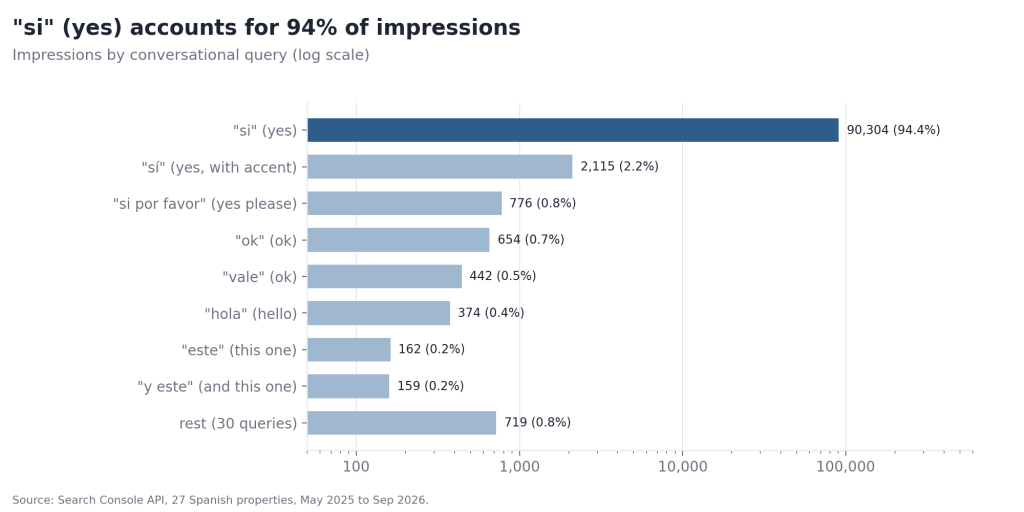
There is an explanation. In my study of which pages Google cites in AI Overviews, with 417 responses from the Spanish sports sector, 30.5% end with a sentence inviting the user to continue: “tell me…”, “I can give you…”, “would you like…?”. And 126 of those 127 sentences cite no source: Google writes them. Below them sits the box to keep asking, which leads to AI Mode. “Si” is the shortest possible reply to that invitation.
Pointing at the screen
“este” (this one), “esta” or “y este” (and this one) mean nothing as a search. They only make sense if there is something in front of the user, usually a product or an image inside the response.
Asking for another format
“con imágenes” (with images), “en español” (in Spanish) or “más corto” (shorter) are instructions, not searches. Image requests appear in 9 of the 27 properties and “in Spanish” requests in 10.
Adding a condition
“y precio” (and price), “y online” (and online) or “y cintura” (and waist) add something to what was already on screen. They are not always conversational, but they say the most about what the response was missing.
“Machines” also leave a trace in your Google Search Console
Not everything that looks conversational is written by a person. In 24 of the 27 GSC properties there are AI visibility tools asking Google about the client’s sector, and in 18 there are agent prompts. Together with brand monitoring tools, they add up to more than 130,000 impressions and just two clicks.
I have to mention Suganthan Mohanadasan here: in his analysis of 16 months of data from his own site, in English, he classified these queries into seven kinds:
- Generated by a person: short replies (“yes”, “sure”), ways of comparing against an alternative (“what about gemini”) and questions addressed to someone (“is it free”).
- Generated by machines, or unclear: footprints from AI visibility tools, full agent prompts and pasted strings.
- Other: long queries with no other signal.
The kinds generated by people match what I found in Spanish, across the 27 properties, with one difference in weight: in his data, long questions dominate, with almost no clicks; in mine, short replies dominate, and they do bring clicks.
And the machine kinds also show up on Spanish sites, along with a third one he does not describe.
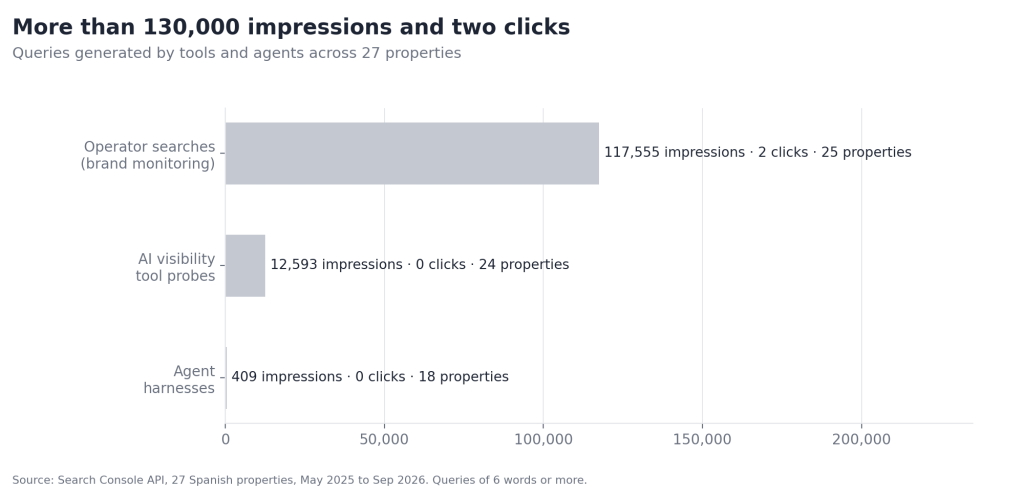
To find them I analysed every query of six words or more across the 27 properties I have access to, over the same 16-month window. For the footprints I looked for the two signatures Suganthan describes.
| What it is | How to spot it | Queries | GSC properties where it appears | Impressions | Clicks |
|---|---|---|---|---|---|
| Footprints from AI visibility tools | “evaluate the [sector] company [brand] on [topic]” or questions ending in “my location is spain.” | 884 | 24 / 27 | 12,593 | 0 |
| Agent prompts | “context: location: spain (not for language). do not include location references in your response. question: …”, in several languages | 134 | 18 / 27 | 409 | 0 |
| Operator searches from monitoring tools | the brand in quotes followed by a list of “-site:reddit.com -site:x.com …” | 3,958 | 25 / 27 | 117,555 | 2 |
Why it matters
- They inflate impressions and drag CTR down. “Machines” don’t click, so on a page that appears in many footprints the CTR falls without anything changing for real users.
- They don’t only evaluate the brand itself. Some footprints evaluate the client’s own brand and others a competitor, and in both cases the client’s site appears in the response.
- They show up in almost every sector. Footprints appear in 24 of the 27 properties I analysed and operator searches in 25, from shops to training centres and hotels.
How to exclude them
This regular expression captures 83% of the machine impressions without dragging in any query from a real person. To filter them out, add a query filter with the “doesn’t match regex” option:
my location is|^evaluate the .+ company|^context: location|-site:|"[^"]+" or "When it started and what explains it
The launch of AI Mode in Spain left no mark on the data. Conversational queries grow with two later changes: the December 2025 test and the January 2026 launch, both designed to move users from AI Overviews into AI Mode.
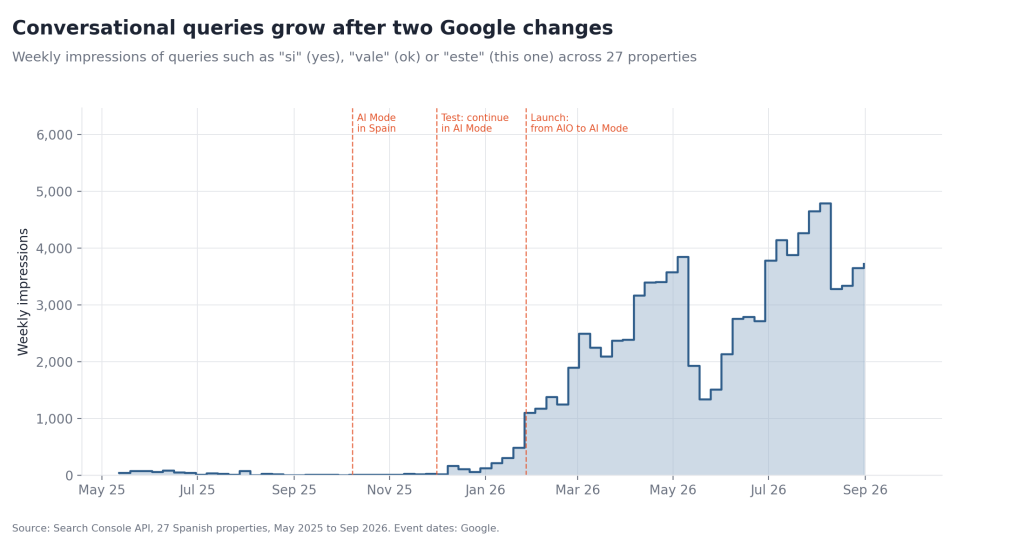
Each Google change, against the data
For each date I compare the two weeks before with the two weeks after, using impressions, clicks and the properties’ total traffic as a reference.
| Date | What Google did | What the data shows |
|---|---|---|
| 6 Oct 2025 | Test: “Show more” leads to AI Mode | No change |
| 8 Oct 2025 | Launches AI Mode in Spain | No change; first scattered appearances |
| 1 Dec 2025 | Global mobile test to continue in AI Mode from the results page | Impressions multiply by 4.4 |
| 27 Jan 2026 | Launches follow-up questions from AI Overviews opening in AI Mode | Impressions ×2.7 and clicks ×3.1 |
| 8 Apr 2026 | Tests the same step on desktop | +37%, with the trend already rising |
| 6 May 2026 | Suggested links for further reading at the end of responses | Possibly related to the 13 May drop |
| 28 Aug 2026 | Tests the question box open by default | +15%, too recent |
The two main jumps hold after removing seasonality. Measured per 100,000 total impressions, the share multiplies by 4.8 in December and by 2.8 in January, with total traffic stable.
My reading: AI Mode was available from October, but few users reached it. Use grows when Google puts the conversation inside the AI Overview itself, which is where users already are. Timing alone does not prove cause, but it fits three things:
- What Google says. When announcing the January change, it explained that in its tests users preferred moving into a conversation without losing context.
- What Suganthan sees in English. On his property, short replies appear in December 2025 and become common in March 2026.
- What the responses do. Three in ten AI Overviews in the Spanish sports sector end by inviting the user to continue, according to the study cited above.
Most properties, in the same month
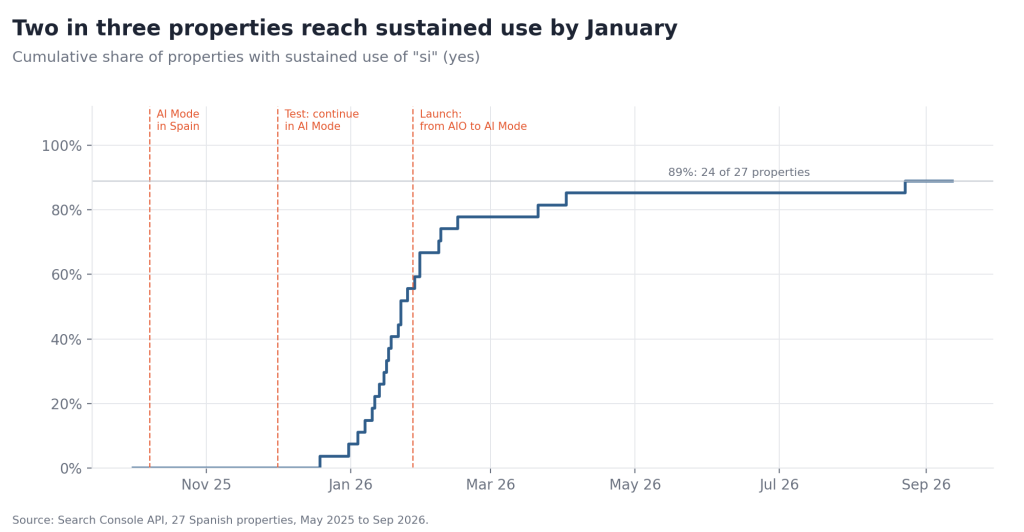
The median date on which use becomes sustained is 21 January 2026. 16 of the 27 properties get there that month, in sectors that have nothing to do with each other. That coincidence points to a Google change rather than gradual adoption.
Each type of reply arrives at a different time
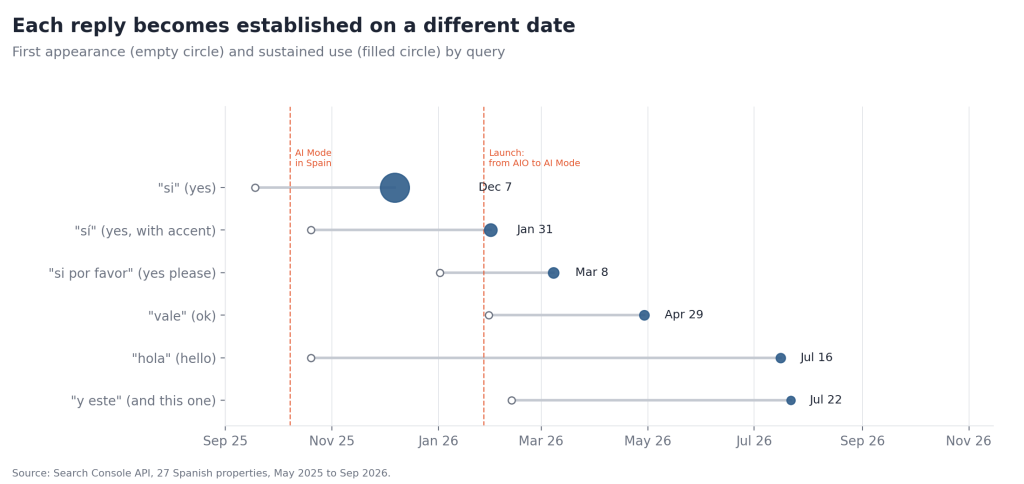
“si” is established first, in December. Then “sí” with an accent (31 January), “si por favor” (yes please, March), “vale” (ok, April) and finally “y este” (and this one, July). Below “si”, volumes are in the hundreds of impressions, so these dates are indicative.
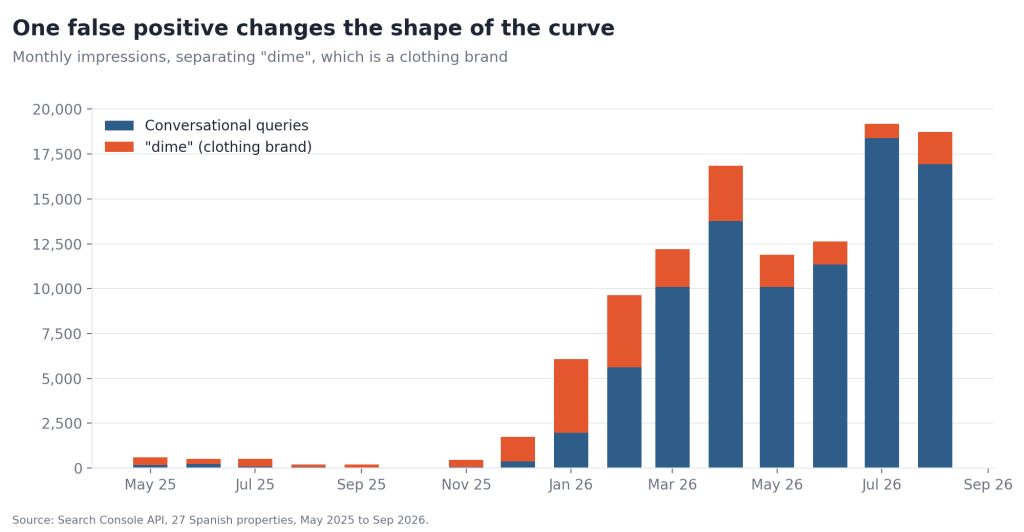
A warning for anyone replicating this: without removing “dime”, which is a brand, the monthly curve overstates January and tells a different story.
The May 2026 drop
On 13 May 2026, conversational queries fell to a third overnight. Total traffic for the same properties did not change, so this is not a general Search Console fault.
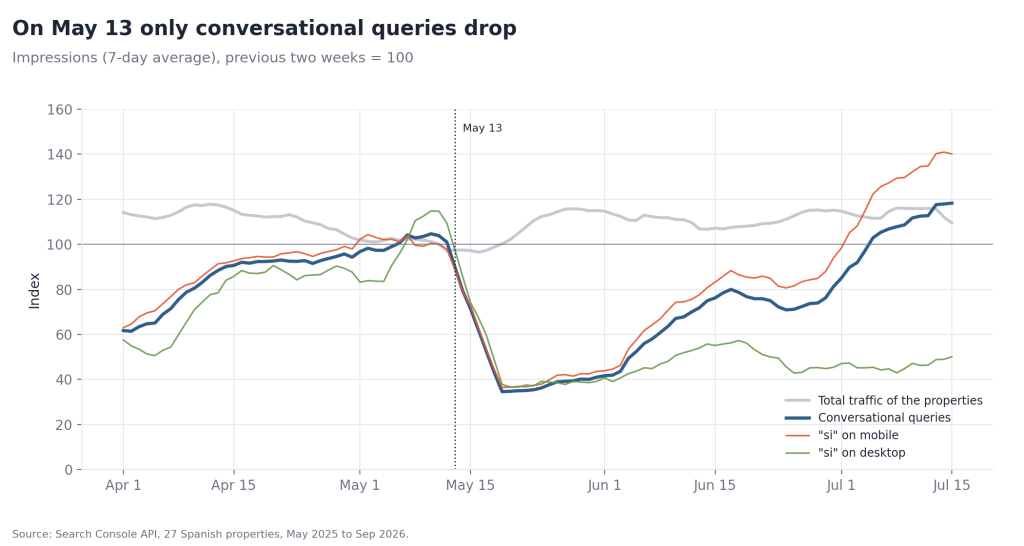
Comparing the two weeks before with the two weeks after:
- Total traffic holds. Impressions +7% and clicks +2% across the 27 properties.
- Conversational queries fall in all of them. They drop from 10.2 to 3.5 impressions per 100,000 of total traffic, on the same day in the 19 properties with enough volume.
- They fall on mobile and desktop. “si” loses 61% on mobile and 62% on desktop.
- They recover differently. On mobile they are back to the previous level by July. On desktop they stay at around half.
The most plausible explanation is the change announced on 6 May, which affects the end of the responses:
If a section appears with links to articles on other angles of the topic, on mobile and desktop, the user follows one of those links instead of replying “si”.
If so, the next conversation turn never happens.
But that is all it is, a hypothesis.
How much they weigh and what clicks they bring
Topic-free conversational queries add up to 3.3 impressions per 100,000 of the properties’ total traffic. Their CTR is 9.7%, against an average of 4.4% for the same properties.
- Weight. Between 1 and 18 impressions per 100,000, depending on the property. It is a floor: Google hides infrequent queries, and conversational ones almost always are.
- Clicks. 25 of the 27 properties have a conversational CTR above their usual CTR; the median is 2.9 times higher.
- Differences between sites. Where the conversation ends in a product, conversational CTR is around 11%; for informational content it stays below 1%. That gap already exists in each site’s normal traffic: compared with its own average, a conversational query multiplies clicks by between 1.4 and 3.9.
Remember how it is counted: the click is on a link in the response Google gives after the “si”. A high CTR does not mean the conversation sends a lot of traffic. It means that, on the few occasions your page appears in that turn, users open it fairly often.
Reverse keyword research: what users asked for because they did not find it
When someone adds “y precio” (and price) or “con imágenes” (with images) in a second turn, they are telling you what the response was missing. And because the export includes the page, you know which URL was in that response.
| Query | Type of site | What it reveals |
|---|---|---|
| “y precio” (and price) | education | the price was not in the response |
| “y online” (and online) | education | the study mode was not covered |
| “y lux” (and lux) | lighting | the technical specification was missing |
| “y cadera”, “y cintura” (and hip, and waist) | aesthetic clinic | the user wanted to complete the calculation |
| “pero fruta” (but fruit) | gardening | the user wanted to narrow down to a category |
| “ahora sol” (now sun) | optician | switching from prescription glasses to sunglasses |
| “con imágenes” (with images) | sport, gardening | the visual support was not enough |
| “más corto” (shorter) | education, informational content | the response was too long |
| “en español” (in Spanish) | several | the user wanted the response in their language |
Each row is a need written in the user’s own words, after seeing your content. You don’t need a keyword tool for this: it is already in your Search Console.
Format requests repeat the most: “in Spanish” appears in 10 properties and image requests in 9.
A word of warning: this search also brings noise. The pages with the most added conditions also show brand variants and topics that were already on the page, so review them by hand before turning them into tasks.
How to find them in your Search Console
If you want to play with the data in your property, there are several regular expressions you can use in Performance → Add filter → Query → Custom (regex).
If your project is international or English-speaking, you can use Jean-Christophe Chouinard’s regex.
If you use AI to write your regex, remember that Google Search Console expects RE2 syntax.
For the Spanish market, here are some recipes based on my data:
1. Short replies
Agreement, politeness, pointing at something and asking for more.
(?i)^(y |pero )?(s[ií]|vale|ok|okey|claro|perfecto|genial|adelante|de acuerdo|gracias|muchas gracias|por favor|s[ií],? por favor|s[ií],? porfa(vor)?|este|esta|estos|estas|ese|esa|esos|esas|ambos|otr[oa]s?|otra vez|de nuevo|repite|sigue|contin[uú]a|m[aá]s opciones|m[aá]s informaci[oó]n|m[aá]s ejemplos|otro ejemplo|otra (imagen|foto|forma|opci[oó]n)|ay[uú]dame|expl[ií]camelo|hola)[ ?!.]*$It deliberately leaves out “dime” (tell me) and “dame” (give me): they collide with brands and product models.
2. Format requests
(?i)^(con (im[aá]genes|fotos|ejemplos)|mu[eé]strame (im[aá]genes|fotos)|ens[eé][nñ]ame (im[aá]genes|fotos)|en espa[nñ]ol|en resumen|en una tabla|m[aá]s (corto|corta|resumido|largo|simple|sencillo|breve)|res[uú]melo|hazlo m[aá]s [a-záéíóúñ]+)( por favor)?[ ?!.]*$3. Added conditions
(?i)^(y|pero|y si|y para|y con|pero sin|pero con|pero en|y en) [^ ]+( [^ ]+)?\??$This one needs manual review: next to “y precio” (and price) or “y online” (and online) you will also get product names. Use it with the page dimension to see which URL was in the response.
Finally:
- Review by hand the ones with the most impressions. If one has a lot of volume and a single page, it could be a brand, a product or automated traffic.
- Use the API instead of the interface. The interface caps at a thousand rows. And watch out for the page dimension: in this study, the same “si” adds up to 90,304 impressions in the export by date and 27,486 in the export by page.
What to do with this in an SEO project
The volume is small, but each query tells you which page was in the conversation and, sometimes, what it was missing.
In your content
- Look at the added conditions as sections to optimise or create. You could read them as facets the response did not cover: does your content cover them?
- Review the pages with format requests. If users ask “with images”, visual support is missing from the response. If they ask “shorter”, a direct or summarised answer at the top is missing. Is your content compatible with these patterns?
- Cover the next step. If the response ends by offering a routine, a comparison or a price and the user says “si”, consider adding it or having a specific piece that answers it. These are topic gaps worth covering.
In your measurement
- Create a segment with the regex and track it month by month.
- Don’t read their position as a ranking. It shows where your link sat inside the response, not your position for that query.
- Annotate Google’s product changes in your reports.
- Compare with the generative AI report in Google Search Console, which gives impressions by page but no queries. On one property, these queries accounted for 0.35% of its impressions on AI surfaces.
With clients and management
- Set expectations. They bring little volume, but when your page appears in that response a click is more likely than in a normal search, especially if the conversation ends in a product.
- Check your brand name. If it contains a conversational word (“más”, “vale”, “dime”), any automated analysis will mistake it for conversation.
Limits
- We don’t have the totals. Using the API and pulling query and page together means Google hides or filters part of the data.
- It doesn’t distinguish surfaces. We don’t know whether a “si” comes from AI Mode, AI Overviews or regular search.
- Correlation is not causation. The changes coincide with confirmed Google launches, but that does not prove them.
- Spain only. I have not checked other markets.
- Few properties of some types. There is a lot of ecommerce and very little editorial content, so CTR differences between site types are indicative.
What keeps me thinking
Three in ten AI Overviews in the Spanish sports sector end with a sentence like these:
- “Puedo prepararte una rutina con series y repeticiones a tu medida.” (I can put together a routine with sets and reps tailored to you.)
- “Te puedo recomendar las alternativas actuales equivalentes en [marca].” (I can recommend the current equivalents from [brand].)
And 94% of what I have measured here is the reply to that invitation: “si”.
What we see in Google Search Console is only what is left of those conversations, and the numbers say as much: three impressions in every hundred thousand. The whole conversation happens somewhere else.
Sources
- MJ Cachón, study on which pages Google cites in AI Overviews (500 queries from the Spanish sports sector, September 2026)
- Anastasia Kourou, LinkedIn post with John Mueller’s reply, August 2026
- Google, What are impressions, position, and clicks?, AI Mode section
- Google, Data anomalies in Search Console
- Google, AI Mode arrives in Spain (Spanish), 8 October 2025
- Robby Stein, announcement of the mobile test, 1 December 2025
- Google, AI Mode in Google Search and AI Overviews get Gemini upgrades, 27 January 2026
- Google, 5 new ways to explore the web with generative AI in Search (Spanish), 6 May 2026
- Google, A new era for AI Search, 19 May 2026
- Search Engine Roundtable: October 2025 test, April 2026 desktop test and August 2026 test
- Search Engine Land, Google updates links within AI Overviews & AI Mode, 6 May 2026
- Glenn Gabe, How To Find And Organize AI Mode Queries, 13 August 2026
- Suganthan Mohanadasan, “Yes, Go On” and How to Track Google AI Mode Traffic, August 2026
- Jean-Christophe Chouinard, regex for AI Mode queries, August 2026
How long have I been creating this content?
In line with other studies, this one has been particularly costly in terms of accessing all the accounts via the API, cleaning the data, preparing it and analysing it.
Furthermore, drawing on English-language literature and the work of other colleagues who had already identified patterns, I have gathered as much information as possible to cross-check findings and uncover new insights.
Also, once I had analysed the data, I looked at declines in the figures to verify whether there were any events that might have caused them.
As with previous studies, it took just under two weeks, but there was daily progress throughout that period
Soy MJ Cachón
Consultora SEO desde 2008, directora de la agencia SEO Laika. Volcada en unir el análisis de datos y el SEO estratégico, con business intelligence usando R, Screaming Frog, SISTRIX, Sitebulb y otras fuentes de datos. Mi filosofía: aprender y compartir.
Explore by subjects
tal vez sea
de tu interés
-
What makes Google to cite you in an AI Overview [mini-study]
When Google shows a user an AI Overview, it provides an answer that cites a handful of pages as sources. The question that instinctively comes to mind: between two pages competing for the same search, why does it cite one and not the other? Does it take into account “how it’s written” at a linguistic … What makes Google to cite you in an AI Overview [mini-study]
Leer artículo