
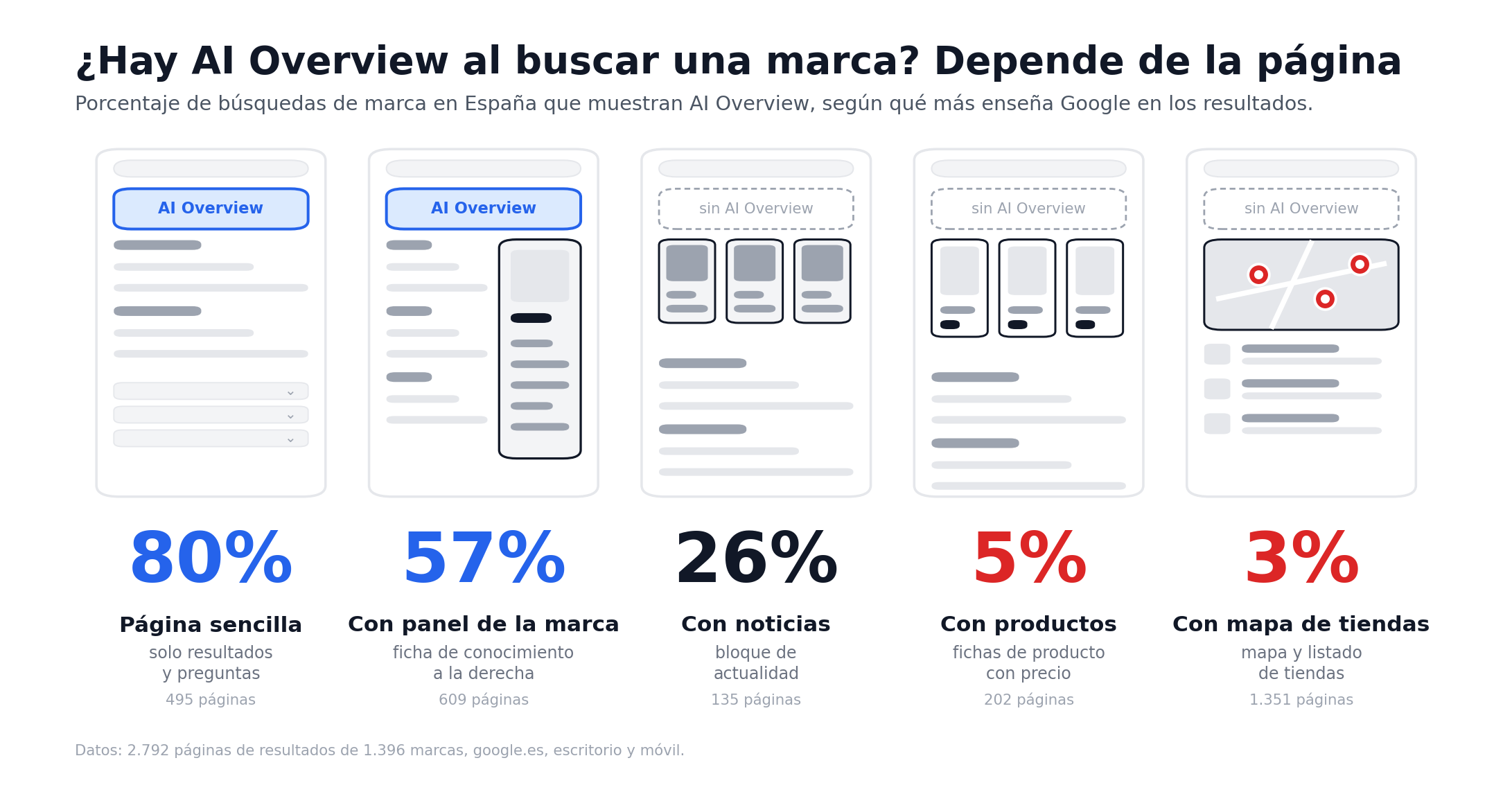
In branded searches in Spain, only 1 in 4 searches shows an AI Overview: 24.7%. What I see carrying the most weight is not the size of the brand, but the elements or blocks Google shows in each search. If there are local packs, products or comparison blocks, there are almost never AI Overviews. However, if the results only show organic listings and questions, the rate of appearance rises to 90%.
What I wanted to check
I saw several tweets and analyses from Nectiv (https://x.com/chris_nectiv/status/2105291766853173700) and DemandSphere (https://www.demandsphere.com/blog/branded-ai-overviews-september-2026/) saying that appearances of AI Overviews in branded searches had multiplied. The data from their tests and analyses:
- 93% of big brands showed AI Overviews in Google. A quick test with 100 brands.
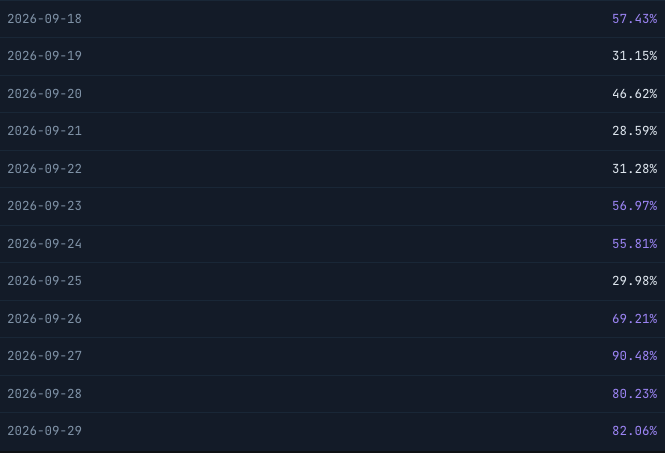
- DemandSphere published its daily tracking series, with a jump from 27% to 82% in the last days of September. A dataset that doesn’t disclose the market breakdown, how many searches they track, what the keywords are like, or whether the percentage includes direct appearances, appearances in the questions block or others.
My questions after seeing both were these:
- Does the same happen in Spain and in Spanish?
- Does it happen with brands of different sizes and sectors, or only with the big digital corporations?
- Is it the same on mobile as on desktop?
So I ran an analysis of 1,400 branded searches, using the DataForSEO API, to try to answer those questions and see whether it is worth repeating month by month to track the evolution.
How I did it
From the 1,400 brands collected, I ran a Python script through Google Colab, for Spain in Spanish, for both the mobile and the desktop versions. In total, I reached 2,792 results pages, since a few searches failed: from 1,400 it ended up at 1,396.
- The brands have at least 1,000 searches per month for their short, direct name. There are 17 commercial sectors and, separately, there are also media brands, digital platforms, institutions and sports clubs.
- The search was run on October 4, with the DataForSEO API.
- For each search, I stored whether or not there are AI Overviews, in which position, which sources it cites, and also which other blocks Google shows.
- A second search for those cases where no AI Overview was shown.
- A manual check in incognito of a sample of 35 searches; in 33 cases it gave exactly the same result as the API.
The main result: 24.7%
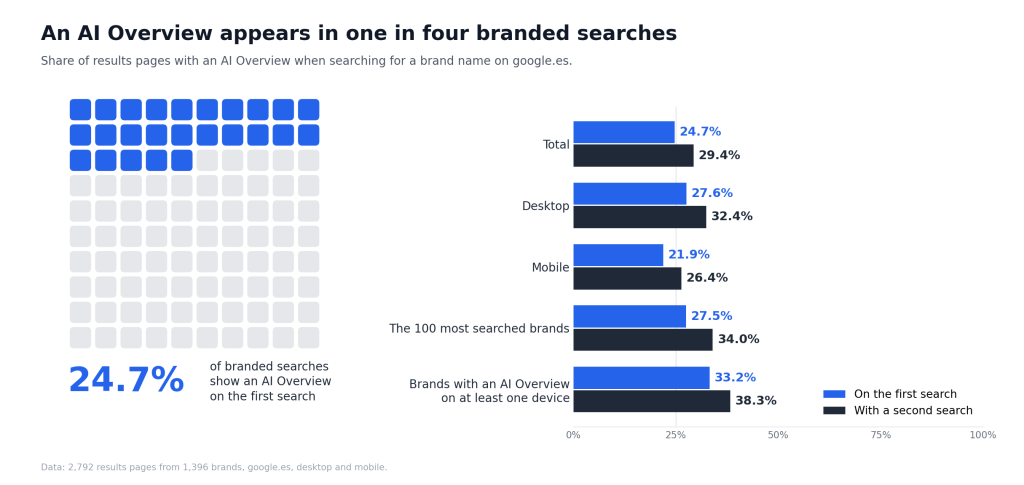
Of all branded searches, 24.7% show AI Overviews. When repeating the search for those where they didn’t appear the first time, the figure rises to 29.4%.
| Searches with AI Overviews | On the first search | With a second search |
|---|---|---|
| Total | 24.7% | 29.4% |
| Desktop | 27.6% | 32.4% |
| Mobile | 21.9% | 26.4% |
| 100 most searched brands | 27.5% | 34.0% |
| AIO on at least one device | 33.2% | 38.3% |
Both figures, 24.7% and 29.4%, will be mentioned throughout the article, since the variable and changing nature of AI-generated answers, their volatility, may be better reflected in the second one.
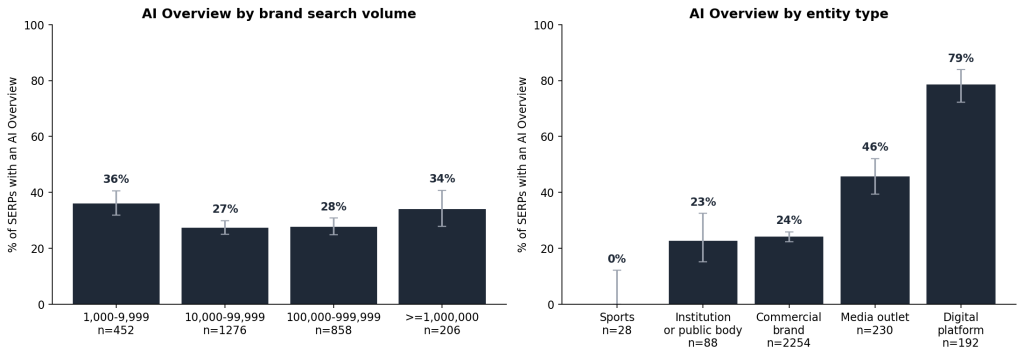
On the other hand, the size of the brand, in terms of organic demand (average monthly searches), doesn’t change whether or not the AI Overviews block appears. In brands with fewer than 10,000 monthly searches, AI Overviews is triggered in 36% of cases, and in brands with more than 1 million, in fewer: 34%.
The AI you don’t see at first glance is in the People Also Ask blocks (user questions)
As Barry Schwartz mentioned in early September with data from AlsoAsked, the user question blocks and their answers are now generated entirely with AI Overviews.
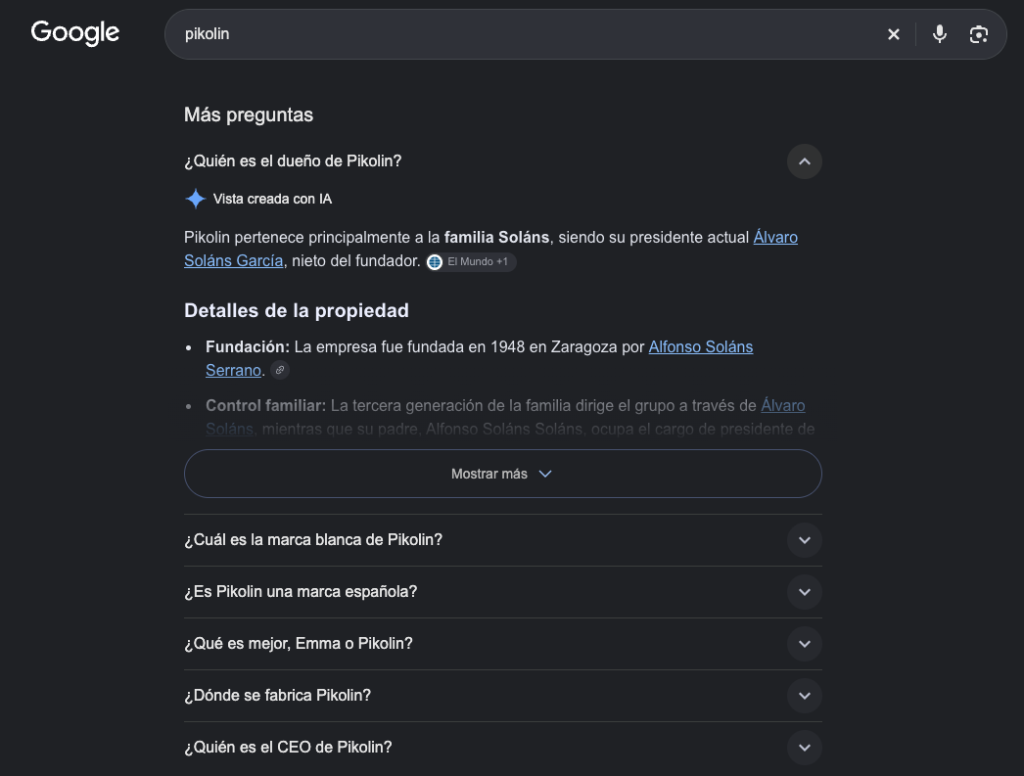
So until those tabs are expanded, you can’t see that AI Overviews is there, instead of appearing at the top of the results page or in intermediate positions, but in a very visual way.
Adding up the two ways of appearing, directly or via the questions block, the figures rise to 8 in 10 branded searches with AI Overviews of one type or the other.
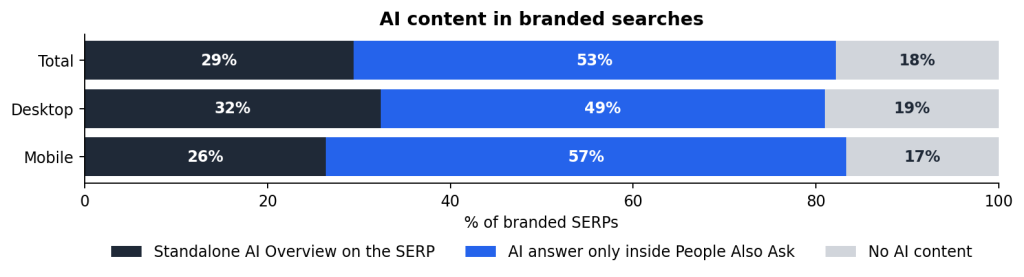
This figure does come close to the Nectiv and DemandSphere studies.
AI Overviews depends on what Google shows on the SERP
The results page and the blocks that are triggered have a greater impact or influence on understanding the map of appearances in branded searches.
When Google already has something concrete to offer, such as local packs or listings, it doesn’t add AI Overviews. However, when the results associated with the brand are simpler, it does show AI Overviews.
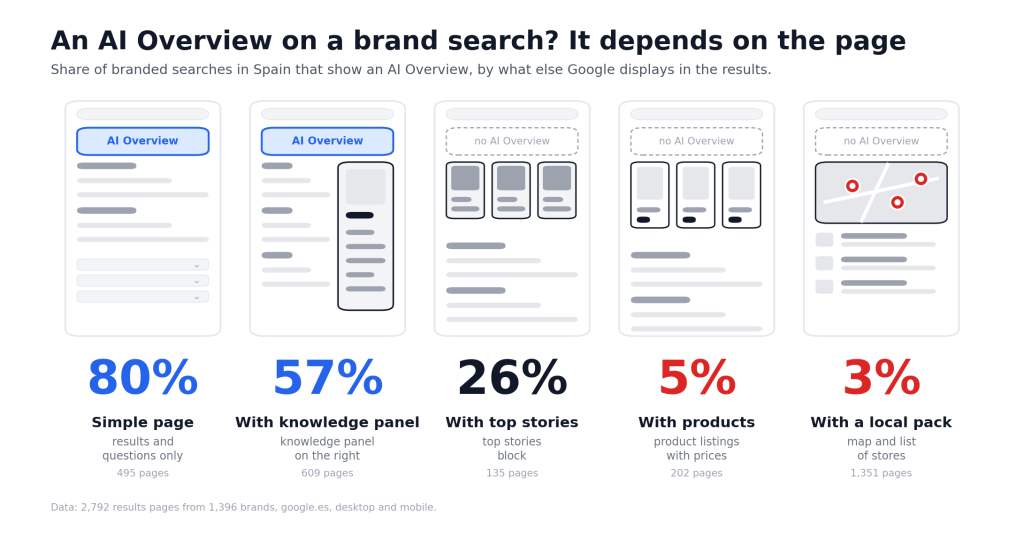
| Type of SERP | Total SERPs | With AI Overviews |
|---|---|---|
| Simple | 495 | 79.6% |
| With brand panel | 609 | 56.7% |
| With news | 135 | 25.9% |
| With listings | 202 | 5.4% |
| With local pack | 1,351 | 2.6% |
Almost half of the branded searches analyzed show a local pack.
In my data, brands like Reddit, Salesforce, Adobe or Facebook have AI Overviews on both devices; Zara, Nike or Samsung, however, have none.
The blocks that, together, exclude AI Overviews
Seeing that with local packs or products AI Overviews dropped sharply in branded searches, I thought: why not cross the data to identify which combination of blocks is the one that leaves AI Overviews out?
And the insight came out: if the SERPs show no local pack, no comparison sites block and no product listings, the percentage of AI Overviews in branded searches rises to 63%.
Seen from the opposite angle: if a local pack and comparison sites appear together, AI Overviews is never shown.
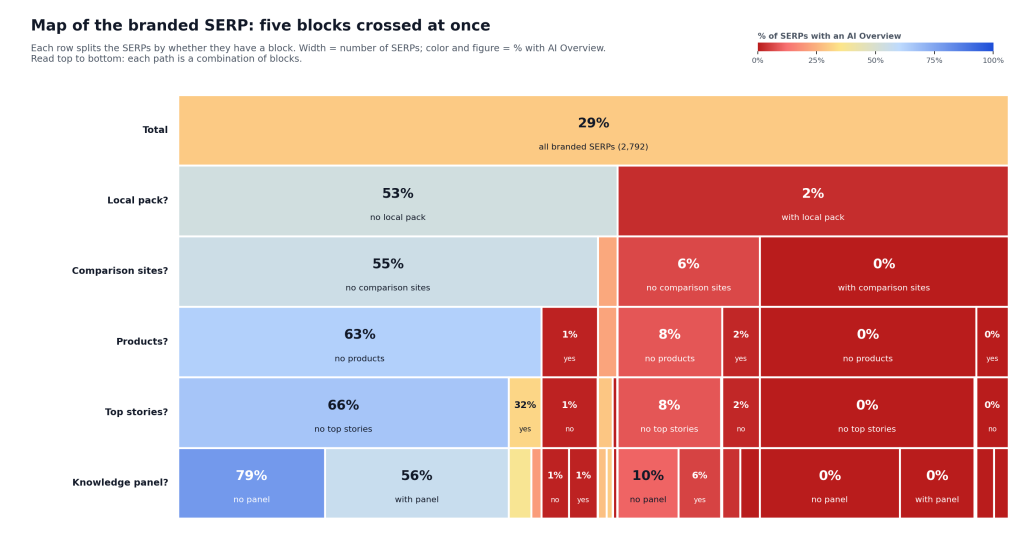
| What the SERP shows | Total SERPs | With AI Overview |
|---|---|---|
| No local pack, no comparison sites, no products | 1,221 | 63.2% |
| Comparison sites only | 64 | 21.9% |
| Local pack only | 351 | 8.3% |
| Products, with or without local pack | 317 | 1.3% |
| Local pack and comparison sites | 837 | 0.0% |
If we look deeper, leaving aside the 3 blocks mentioned, we can see that other blocks emerge that can alter the final rate of appearance:
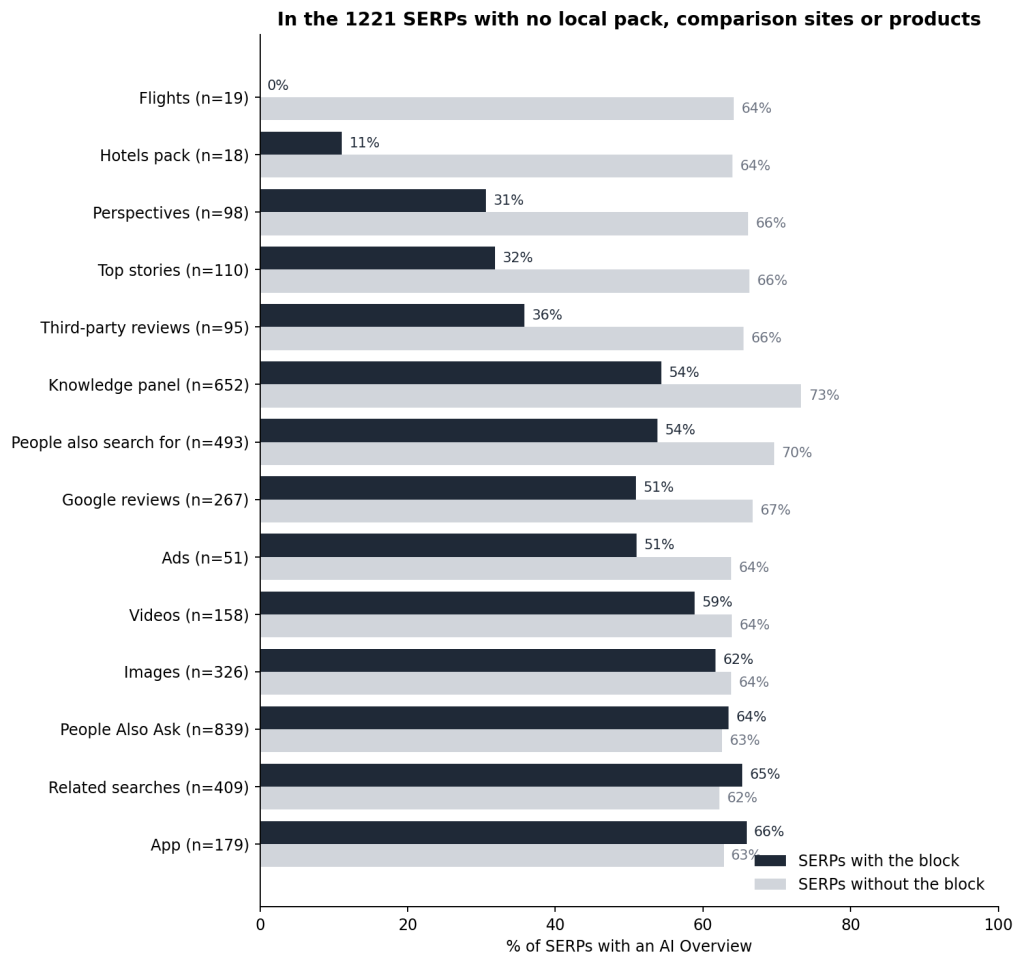
So the general rule is that the simpler the results page, the more likely AI Overviews is to appear, and here is another figure from this study: SERPs that show AI Overviews also show, on average, 2.8 types of block; those that don’t show AI Overviews, 4.2 types of block.
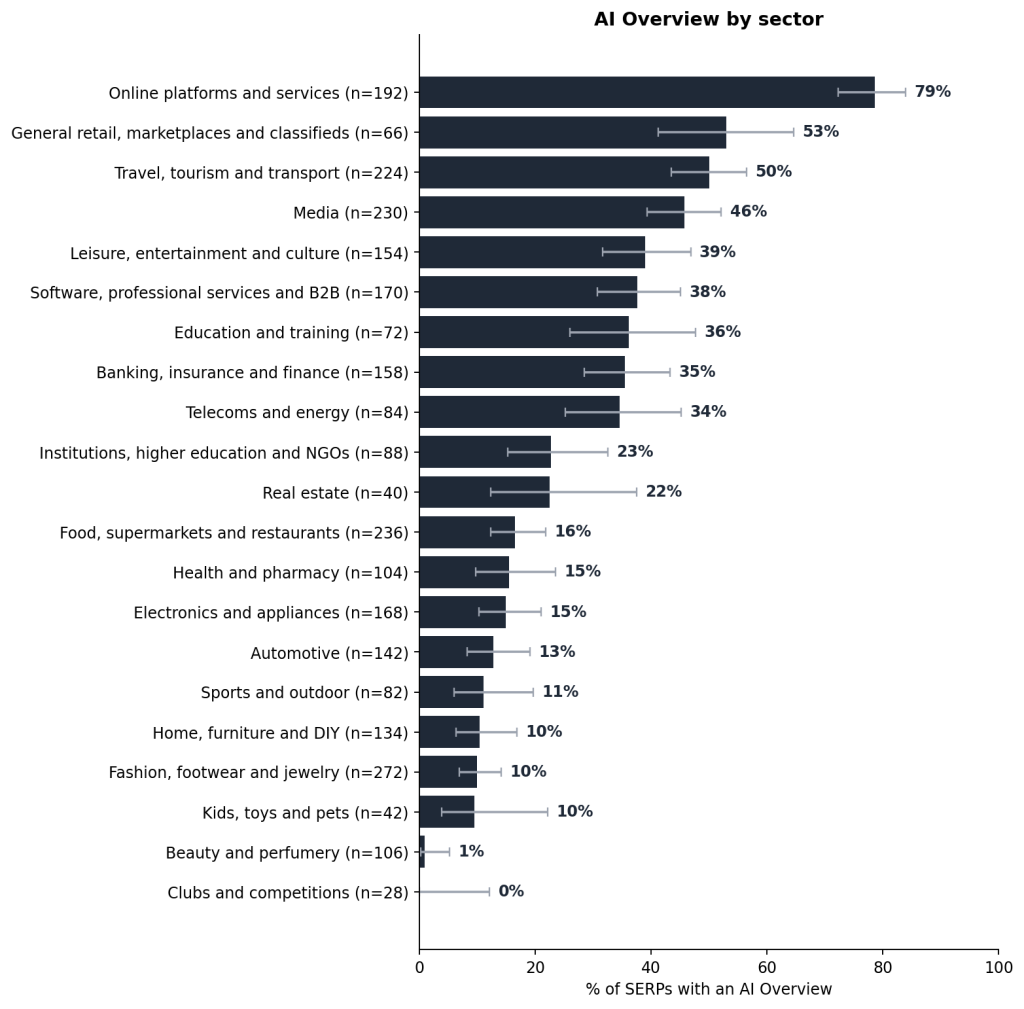
Does the appearance of AI Overviews change by sector?
Well, whoever is able to trigger a local pack on their branded search is, for now, spared a little from AI. If we look closely, digital platforms reach an AI Overviews presence of 79%, travel 50%, and other sectors such as Fashion or Beauty stay at 10% and 1% respectively.
Where the AI block appears and who it cites
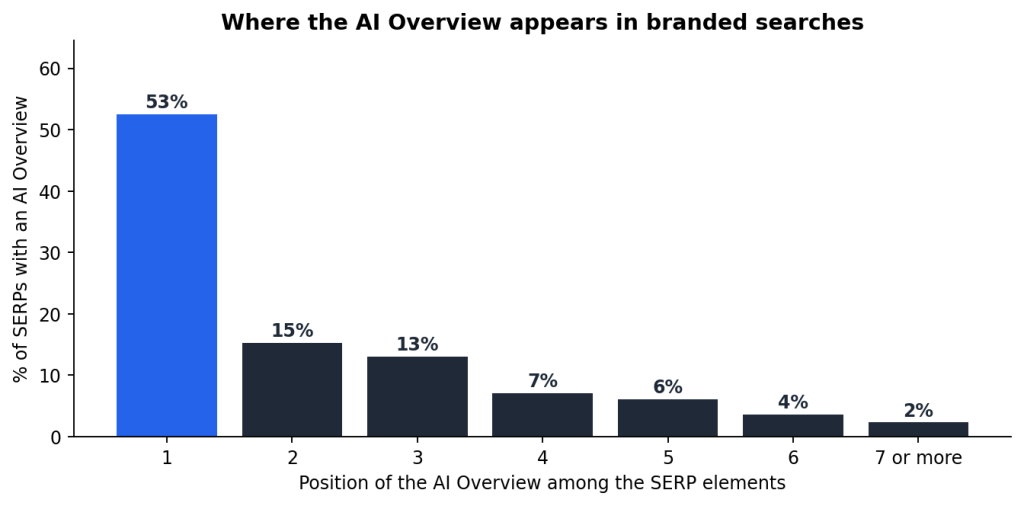
With the data I’m working with in this study, what I observe is that AI Overviews appears in first position half of the time; the rest of the time there are results above it, usually the brand’s website (86.3%).
In addition, analyzing the text of AI Overviews, the brand is cited 88% of the time, and in 76% of cases it is the first citation.
This suggests there is a percentage in which part of our brand “can be stolen” from us, with others gaining visibility or even clicks at our expense. Tough.
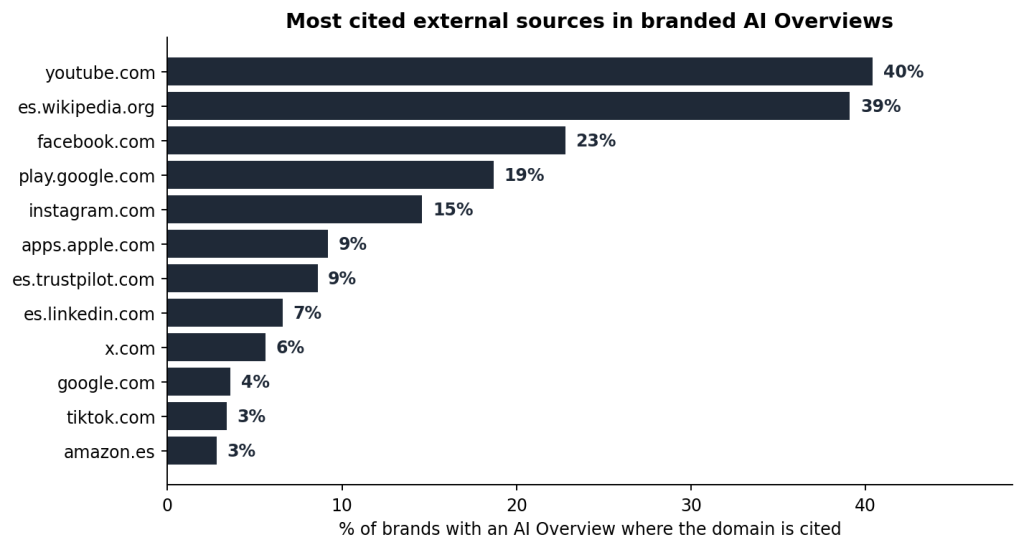
If we look at the cited sources that are external to the brands, the usual suspects come up, everything that surrounds the brand’s reputation and identity: mainly social networks, marketplaces, and opinion and review sites.
Methodology, limitations and statistical treatment
Methodology and limitations
- Sample: 1,396 brands with at least 1,000 monthly searches for their name in Spain. It is not a random sample of all the brands in the country.
- Searches: 2,792 results pages (desktop and mobile) on October 4, 2026, with DataForSEO, location Spain, language Spanish and loading of asynchronous AI Overviews enabled.
- What counts as an AI Overview: a standalone block on the page. AI answers inside the questions are counted separately.
- Intermittency: the branded AI Overview doesn’t always appear. When repeating the search, 6.1% of the pages that didn’t have it showed it.
- Manual validation: 35 searches reviewed in incognito; 33 matched the tool.
- Location: the searches were run at country level. From a specific city, local results may vary.
- Association, not cause: the fact that the local pack and the AI Overview don’t coincide doesn’t prove that one prevents the other. Google decides both at once depending on how it interprets the search.
- It’s a snapshot: it reflects one specific day. Google is changing this behavior week by week.
Statistical treatment
Statistical tests have been applied, such as confidence intervals, comparison tests between groups and a regression model that analyzes all the factors at once. All of this in order to check that the differences are not due to chance.
- Margin of error: each percentage has its 95% confidence interval. The overall figure moves about two points up or down.
- Desktop versus mobile: the difference is statistically significant. There are more AI Overviews on desktop.
- Local pack, products and comparison sites: their relationship with the absence of an AI Overview holds when all the factors are analyzed together.
- What weighs most: knowing which blocks the page shows predicts whether there will be an AI Overview much better than knowing the size or type of brand.
Conclusions for SEO projects and for brands
We have always focused projects on ranking for searches from users who don’t know us and who search for terms without the brand. Historically, that has been one of the levers of organic growth.
When it came to ranking for brand terms, with rare exceptions, it was common to rank “without doing anything”. Unless the brand had reputation problems or technical problems (indexing, internationalization, performance…), it didn’t get the same attention as generic rankings.
Despite certain opportunities for improvement in brand rankings, there is now a new and growing upturn in the importance of the brand in SEO (and GEO) projects.
AI has accelerated this process, and this study reflects certain gaps in brand rankings through which third parties outside the project could slip in.
It is therefore vital to monitor those gaps and try to fill them, if not with the brand’s own website, then with digital assets that it does control, closing the door to third parties so that they can’t capitalize on even small fractions of the brand.
Monitor not only the gaps, but also the answers that AI Overviews offers, to validate whether the content is correct and whether it is getting it from the main sources (the official brand) or where it is getting it from.
This will also give clues about which content or formats may be likely to split attention in the results.
So now you know: monitor what you can, but don’t settle for a static snapshot of a single day. AI Overviews change and are variable, like everything that has to do with AI.
How long has it taken me to do this?
I know that working on a Sunday isn’t ideal, but it was the only time I had to do this. I focused on:
Defining the study, identifying the words to extract, setting up Google Colab, testing it, cleaning the data and analysing it
Summarising all of that in an article in Spanish and another in English
I used Claude to validate the code and generate the graphs.
In total, about 10–12 hours
Soy MJ Cachón
Consultora SEO desde 2008, directora de la agencia SEO Laika. Volcada en unir el análisis de datos y el SEO estratégico, con business intelligence usando R, Screaming Frog, SISTRIX, Sitebulb y otras fuentes de datos. Mi filosofía: aprender y compartir.
Explore by subjects
tal vez sea
de tu interés
-
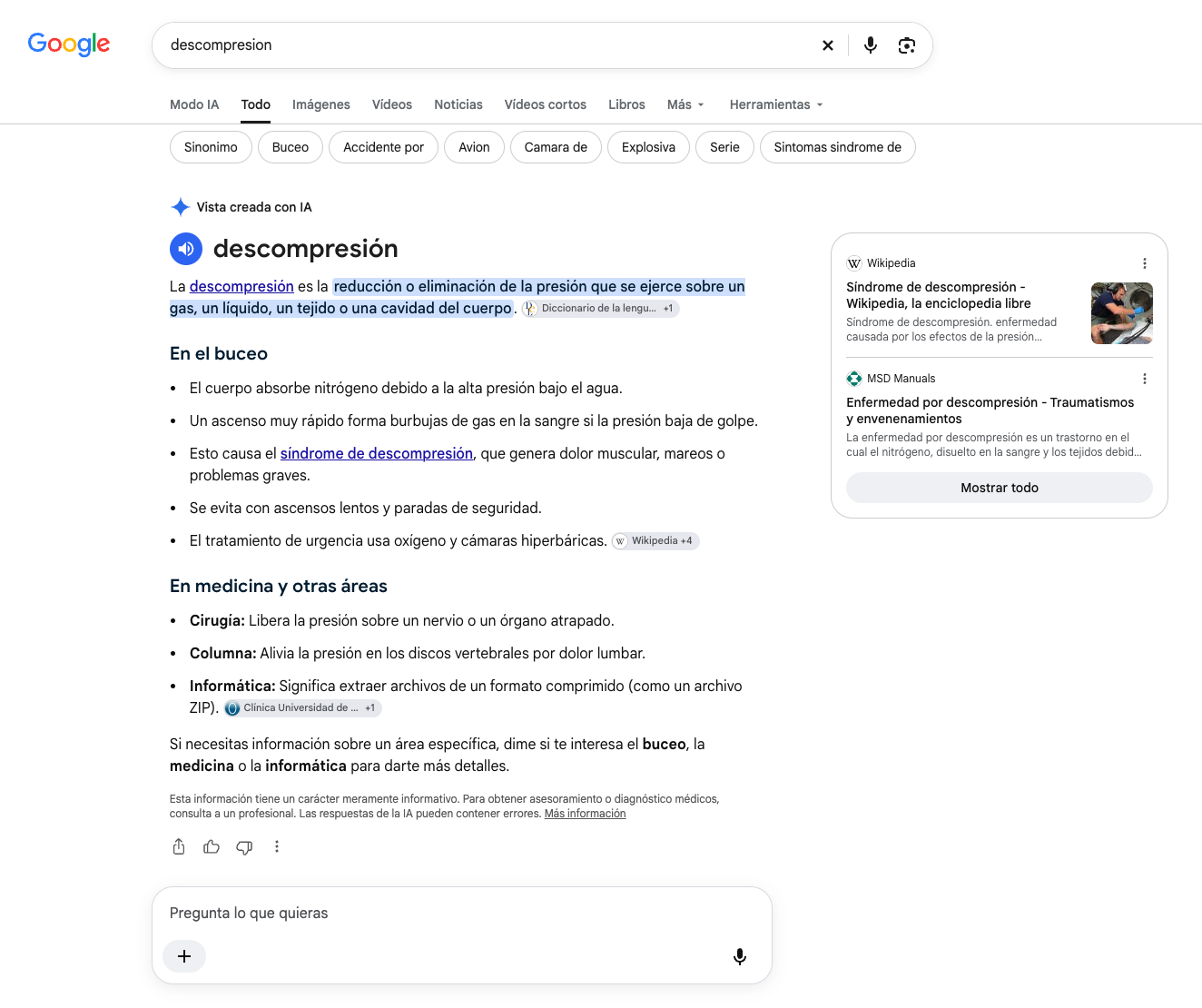
What makes Google to cite you in an AI Overview [mini-study]
When Google shows a user an AI Overview, it provides an answer that cites a handful of pages as sources. The question that instinctively comes to mind: between two pages competing for the same search, why does it cite one and not the other? Does it take into account “how it’s written” at a linguistic … What makes Google to cite you in an AI Overview [mini-study]
Leer artículo -
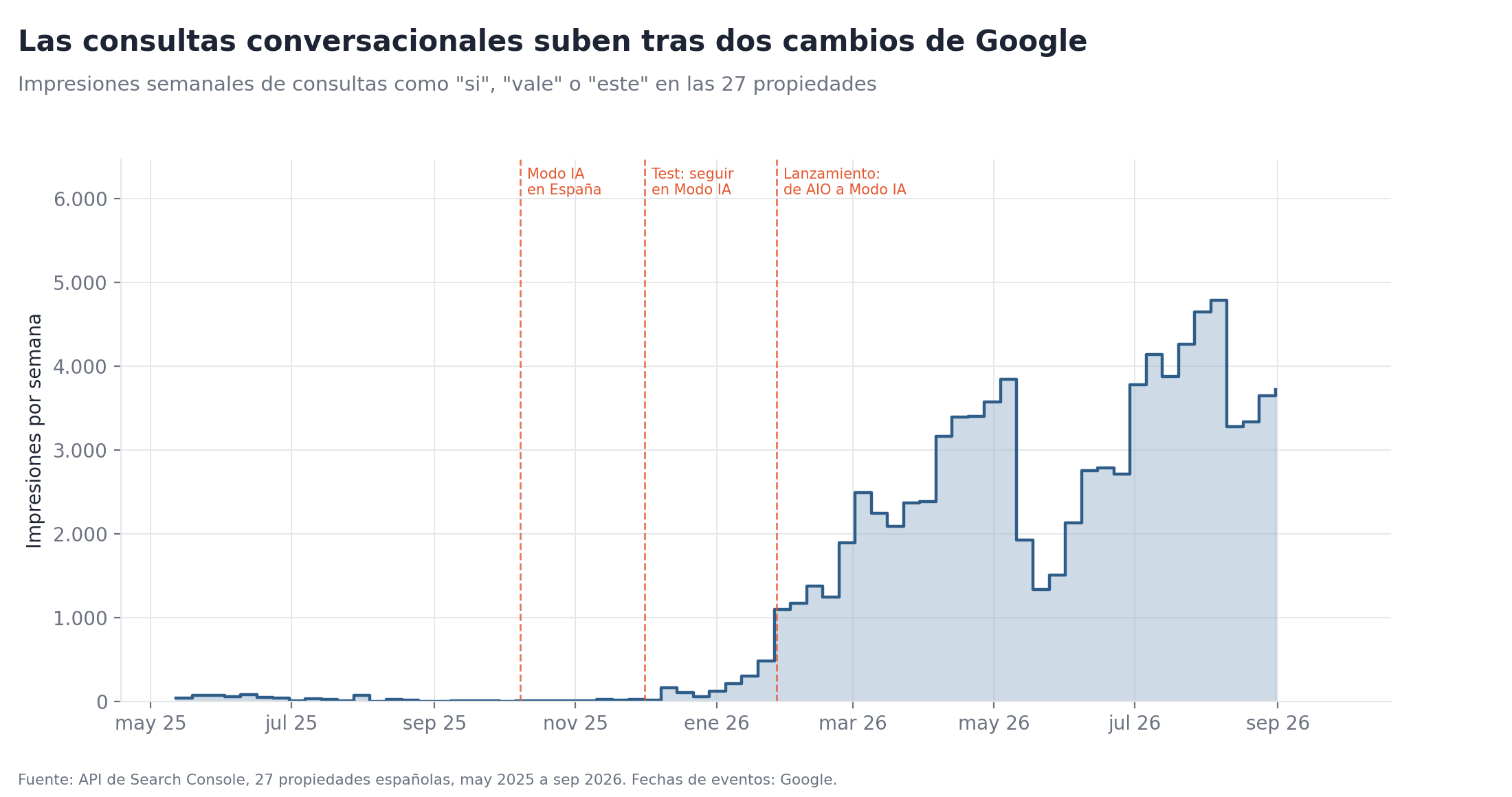
Conversational queries in Google Search Console: a study of 27 accounts
16 months of data from 27 Spanish properties across very different sectors, to figure out whether Search Console was recording what people say to the AI
Leer artículo