
If Day 1 was science, Day 2 was psychology — above all the psychology of the customer who no longer searches the way they used to, of the executive demanding “an AI strategy, now,” of the writer afraid of being made obsolete, and of the SEO who discovers that 91% of the citations showing up in AI answers come from sites they don’t control.
10 speakers (Will Reynolds, Bianca Anderson, John Doherty, Garrett Sussman, Azeem Ahmad, Brittan King, Amanda Milligan, Alex Halliday, Ian Lurie and Angela Clark) arrived at a common place: the discipline we used to call SEO is turning into a blend of brand management, behavioural science, organisational change management and systems design. What’s changing isn’t the tactic. It’s the job.
This is the recap. It opens with 5 ideas and then goes talk by talk, in agenda order, to squeeze out the details and add context for those of us who were there.
TL;DR — The 5 ideas that tie Day 2 of #SEOWeek 2026 together
- Trust is the new KPI, and it’s earned off your site. 91% of citations in AI answers come from forums, reviews, press and communities. Visibility without credibility doesn’t convert, and credibility is no longer built only on your domain — it’s built on Reddit, on G2, in directories, in press mentions, and in how the people who don’t get paid by you talk about you.
- Search has become so personalised that there’s no longer a single SERP. Data from Gmail, Calendar and Photos changes the recommendations AI gives each user. And the audience, on top of that, is fractured generationally — for example, Gen Z searches on TikTok, boomers cling to Google, “digital explorers” delegate to ChatGPT. A single-channel strategy could be leaving up to 40% of your market out.
- Human is no longer decoration — it’s the margin lever. John Doherty said it without sugarcoating: the “middleman” (the person who used to produce) is dead. AI does 80% of the work. What remains and gets paid well is the other 20%: taste, the right questions, nuance, editing, editorial judgement. Agencies that keep selling hours lose; the ones selling outcomes win.
- SEO no longer controls SEO. What it controls is influence. Bianca Anderson and Garrett Sussman framed it from different but converging angles. The lever for SEO in 2026 is cross-functional (Email, PR, Community, Product, Legal). The winning strategy doesn’t fight those territories — it approaches them with a “constraints first” and “SEO as an internal service” mindset.
- Fear is real, and managing it is part of the job. Brittan King and Angela Clark named it without dressing it up. There’s anxiety, there’s FUD, there’s “is this making me dumber?”. The answer isn’t to ignore it or surrender — it’s cognitive sovereignty, frameworks like H.U.M.A.N., and reinvesting the time AI frees up into the work only “the person” can do.
The 10 talks of Day 2 of #SEOWeek 2026, one by one
Below, a brief recap of each session in the order they were delivered.
11 Will Reynolds
Speaker: Will Reynolds
Talk: SEO is a performance channel, GEO isn’t. How do you pivot?
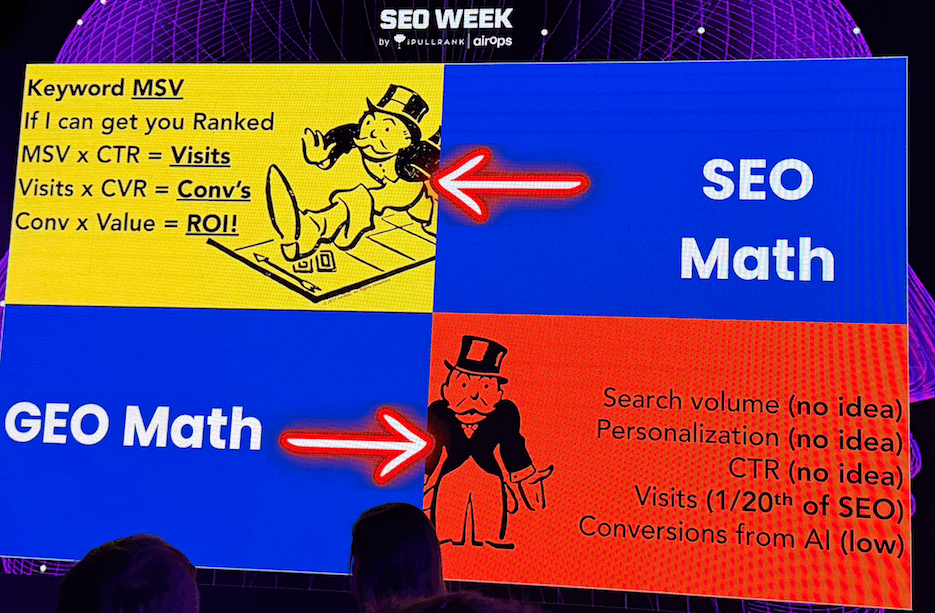
“SEO is a performance channel, GEO isn’t.” Will opened the day banging his fist on the table to argue that measuring GEO the way we measured SEO is setting yourself up to fail.
Visibility is just the first door (“seen, believed, chosen”) — without credibility and choice there’s no business. His indictment of the industry was direct: he believes we’re flooding the web with “zombie content” (automated listicles nobody wants to read) to inflate vanity metrics while AI takes control of the brand narrative.
The most uncomfortable idea is that 50% of the time, users put brands they already know inside their prompts. If your brand isn’t being described accurately by ChatGPT, Gemini or Claude, somebody else is describing it for you — usually with biased data or isolated reviews.
The answer isn’t to produce more, but to audit how AI describes you, publish real and forceful data that rewrites that narrative, and stop accepting impression reports as proof of impact.
The line: “If you put trust as a KPI, you can be Michelin. If you don’t, you can be Madoff.”
Follow the author:
12 Bianca Anderson
Speaker: Bianca Anderson
Talk: SEOs Own Less Than We Think: The Influence Gap No One Trains You For
Bianca dropped a stat on the table that reshapes the whole conversation: 91% of the citations AI uses to build its answers don’t come from the SEO’s site, but from forums, third-party reviews, press mentions and communities. In other words, 91% of the critical work lives outside the ‘SEO’ column on the org chart — it’s owned by PR, Brand, Product, Legal, Community.
Trying to ‘own’ that is wasting your time. The smart play is to influence.
Her framework is called Constraints First — so before planning a campaign, she sits down with Legal and asks them what they’re afraid of, turns their fears into parameters, and builds on top of them.
At Hims & Hers, that approach unlocked competitor comparison pages that drove seven-figure revenue and dodged the penalties of the February 2026 update.
Her second big tactic, Make It Theirs, is about handing the creative starting point to whoever brings the most value. When she stopped suffocating her writers with rigid keyword-based briefs and let them pitch angles, content doubled its conversion rate and started outranking Reddit threads.
The line: “You can’t mandate that humanity exists in content. You can only create the conditions for it to happen.”
Follow the author:
13 John Doherty
Speaker: John Doherty
Talk: The Death of the Middleman: Why “Good Enough” AI is Killing Traditional Marketing
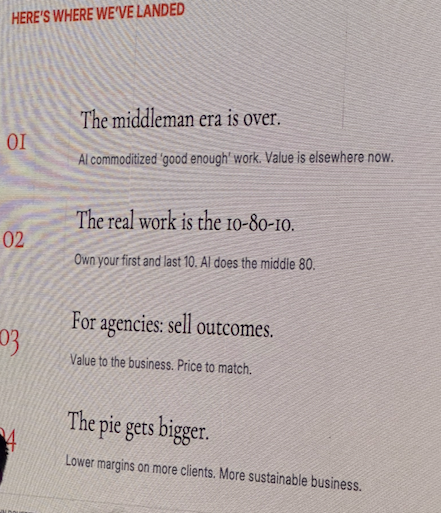
The most “provocative” — or rather, the most direct — talk. John’s thesis is brutally simple: for decades, marketing was a headcount business. More output meant more hands. The era of the “middleman” (the human who produced, drafted, resized and routed the work) is over.
AI has commoditised “good enough” execution, and what used to take weeks now takes minutes, maybe seconds.
“AI can create the content, but it can’t create the people. And the corporate pyramid — producers at the bottom, managers in the middle, strategists at the top — has already collapsed. We’re all builders and strategists now.”
The clash comes from the fact that if AI can do the task, that task is no longer your value proposition.
Agencies that survive won’t sell hours, they’ll sell outcomes.
In-house teams that survive will fight for strategy, distribution and change management.
John proposed a simple operating framework, the 10-80-10 model.
- The first 10% is human (direction, ideation).
- The 80% is done by AI.
- The final 10% goes back to a human (judgement-based review, decision-making, distribution).
And the takeaway: you have to cultivate the ‘unpromptable’ skills (empathy, ethics, taste), because they’re the only thing the model can’t replicate.
Follow the author:
14 Garrett Sussman
Speaker: Garrett Sussman
Talk: Run Persona Run: A year in the life of me, myself, and AI
If Bianca broke the idea that SEO controls its channel, Garrett shattered the idea that there’s a single SERP.
His talk wraps up a year-long experiment with synthetic personas (Google accounts seeded with different profiles) testing how AI’s recommendations change depending on the user.
AI mode in search went from 5% to roughly 25% over twelve months — and what AI recommends depends on who’s asking.
The most damning experiment: seeding an account with emails (even unread spam) that mentioned certain brands made those brands appear up to 80% more often in that user’s AI recommendations.
The inbox is now another ranking signal — and even physical mail scanned by services like Informed Delivery shows up in the answers.
Query fanout gets personalised per persona, so if AI infers you have kids, it suggests ‘streaming services for children’ even if you never mentioned them.
His recommendation: stop auditing your visibility as a single, generic SEO. Build synthetic “search twins” (Gmail accounts with different profiles, subscribed to your industry’s newsletters, fed the behaviour of your audience) and monitor from there.
Start talking to your email marketing team — what they do directly affects how AI recommends your brand.
Follow the author:
15 Azeem Ahmad
Speaker: Azeem Ahmad
Talk: How YOU can Navigate the Fractured Funnel and the Rise of Delegated Choice Using Behavioural Science
Azeem brought behavioural psychology to the table through the idea that the funnel isn’t broken — it’s psychologically fractured, and that fracture runs along a generational line.
Human behaviour is still dominated by two old biases:
the Default Effect (accepting the pre-set option) the Status Quo Bias (resisting change) — but the “default option” is no longer the same for everyone. His four-paths map is a very handy cheat sheet:
- Gen Z and Alpha start and end on TikTok (visual search, social validation)
- Hybrids — Millennials and Gen X — start on Google by inertia but jump to Reddit or YouTube to validate, and to AI when Google fails
- Boomers are anchored to Google and actively reject AI (72% of those over 65 have never used it)
- Digital Explorers — high-income — delegate massively to ChatGPT and buy whatever AI recommends without comparing
The consequence: a strategy centred only on Google leaves up to 40% of your audience out. And “delegated choice” (when you let AI decide for you) silently inherits the model’s bias.
What’s worth auditing: if you’re not the default option ChatGPT recommends in your category, you’re losing share before the customer even knows you exist.
Follow the author:
16 Brittan King
Speaker: Brittan King
Talk: Managing the FUD Out of Change
A talk that was emotionally necessary — it set tactics aside and named what she sees happening inside teams: fear, uncertainty and doubt (FUD).
It’s not a personal feeling, it’s the amygdala hijacking the brain — budget, hiring and strategy decisions are being made from panic, not from clarity.
Her central concept is cognitive sovereignty — the ability to remain the genuine author of your own thoughts when the entire ecosystem (media, social, bosses) is optimised to make you react.
Neuroscience tells us that the brain perceives uncertainty as more stressful than bad news, which is why the mantra of “we don’t know what’s going to happen with AI” paralyses more than any concrete data point.
The reframe she proposed is turning FUD into F.U.D.:
- Fuel
- Understanding
- Discernment
And the warning: “The future will reward clarity, but punish certainty.” Make decisions with clear direction, not with perfect data.
Follow the author:
17 Amanda Milligan
Speaker: Amanda Milligan
Talk: Learning from “Trifecta” Content – Pages That Drive Rankings, Visibility, and Engagement
Amanda picked up the gauntlet of the question what does ‘quality’ even mean now? Her answer is that ‘high quality’ is no longer the exception — it’s the baseline, the bare minimum required to earn the right to show up.
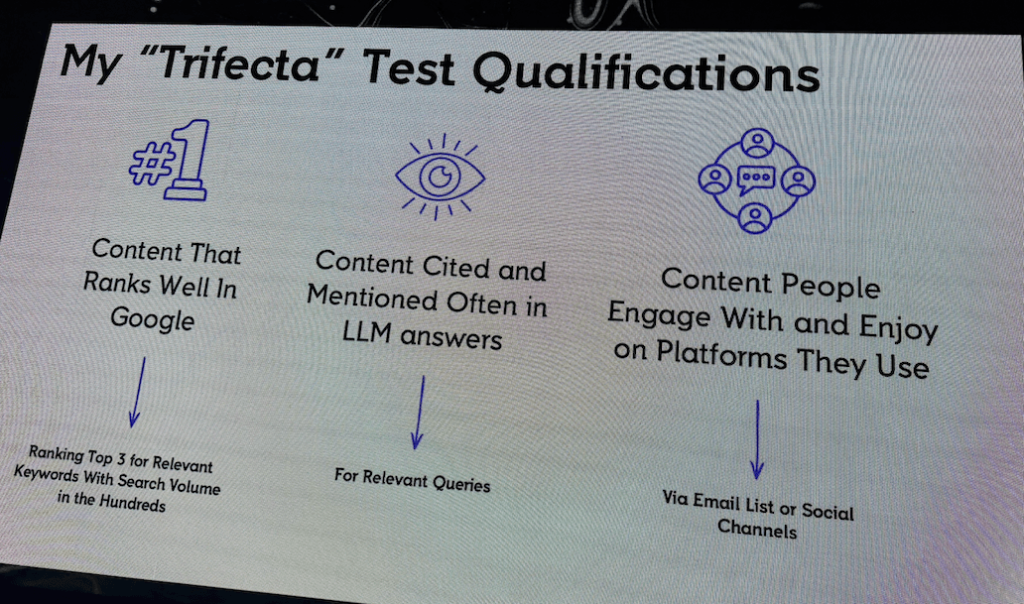
And in a world with multiple gatekeepers (Google, YouTube, TikTok, the LLMs), producing separate pieces for each platform is inefficient. What works is what she called Trifecta Content, a single piece that:
- (1) ranks in the top 3 on Google
- (2) gets cited by AI
- (3) drives above-average engagement on social or email.
Her examples are useful because they’re reproducible:
Angie turns its internal home-improvement pricing data into guides that dominate organic, AI and newsletter conversion King Arthur Baking built an ingredient weight conversion table that’s cited by AI and celebrated on Reddit Painting and Chocolate competes with big brands through deep visual tutorials AI can’t replicate. 3 levers for building Trifecta:
- proprietary data (publish what only you have)
- complex visual problems (where AI can’t reach)
- coining names (HubSpot did it with “Loop Marketing”). If your brand has its own process without a name, naming it is a long-term brand advantage.
Follow the author:
18 Alex Halliday
Speaker: Alex Halliday
Talk: Quality Wins: How to Scale AI Content Without Losing What Makes It Work
Alex (CEO of AirOps) brought the data to try to answer the question what exactly does generative search reward? His answer combines quantitative findings with an operating framework.
- (1) the unit AI evaluates is the passage — fragments of 75 to 200 words with a clear heading, dates, comparisons and zero filler.
- (2) Content published or updated in the last 3 months is three times more likely to be cited.
- (3) Organic position still rules: position 1 has a 58.4% citation probability; it drops to 14.2% lower at the bottom positions.
- (4) “AI content factories” with no human review get penalised.
His proposal is what he calls “content systems,” with four layers:
- a context layer (voice, values and brand guidelines — where he recommends spending 70% of the effort)
- channel intelligence execution with AI agents
- a measurable operating model.
The line: “Content is a competitive sport. You have to build the playbook to win today and the plan to get ahead tomorrow.”
Follow the author:
19 Ian Lurie
Speaker: Ian Lurie
Talk: Teach The Shit Out Of Everything
Ian proposed the most time-resistant strategy and the simplest one to explain: teach. His historical argument — the 1900 Michelin Guide — is perfect: Michelin didn’t sell tyres by teaching people how to sell them; it taught them how to travel, and then sold tyres. Today, DigitalOcean and Silca dominate AI and organic for the same reason: they give away useful knowledge with no friction.
His technical thesis is that every algorithm — human, search or AI — is selling the same thing: trust. Trust Rank, EEAT, RAG, RLHF… it’s all credibility infrastructure. And teaching is the only tactic that organically triggers the signals those algorithms are looking for: time on page, mentions, recommendations.
To do it at scale without dying in the research, Ian shared his LLM Wiki system: Obsidian + a web clipper + Claude. Dump Reddit threads, support tickets, sales call transcripts and raw notes into Markdown folders; let a model process up to 5,000 documents at a time; the output is a knowledge wiki that automatically surfaces the unanswered questions in your industry. And he closed with a useful mental balance: alternate teach big (courses, major guides, high risk) with teach small (a tip on a product page, an Instagram post, a “did you know?” on a landing page). If you teach small, you fail small.
Follow the author:
20 Angela Clark
Speaker: Angela Clark
Talk: I Have a Degree for This: Reclaiming Your Expertise, Identity, and Edge in an AI-Mandated World
Angela closed the day with the most personal — and in many ways the most necessary — talk: the one for the person who’s been hearing all day “AI is going to change everything” and is silently wondering, is this making me dumber?
Her data is striking:
- 97% of agencies and companies already mandate the use of AI.
- 56.6% of staff feel curious 15.7% — concentrated among engineers, strategists and analysts — reject it due to a lack of clear methodologies.
- And nearly 45.3% are considering changing industries. Her most important contribution is that the time AI frees up doesn’t disappear — it shifts.
The first draft takes less time, but the review, source-checking, editing and quality control layer eats up the time saved.
Hallucination rates sit between 1.8% and 7%; she showed a real case where AI projected a fake ROI of 2 million based purely on search volume. Without human auditing, that number reaches the CEO.
The framework she proposes is called H.U.M.A.N.:
Humanise the content Uncover real time savings Make space for meaningful work Teach your colleagues Never stop evolving. The line: “Your boss hires you for your EEAT. You have the degree. The robot doesn’t.”
Follow the author:
Read the SEOWeek Day 1 summary
Read the SEOWeek Day 3 summary
Read the SEOWeek Day 4 summary
Soy MJ Cachón
Consultora SEO desde 2008, directora de la agencia SEO Laika. Volcada en unir el análisis de datos y el SEO estratégico, con business intelligence usando R, Screaming Frog, SISTRIX, Sitebulb y otras fuentes de datos. Mi filosofía: aprender y compartir.