
Euro 2024 has lasted a month and already has a winner: Spain!
But …. Does the pattern repeat itself if we look at the players and teams that have accumulated the most searches on Google, before and during the European Championship?
EURO WINNERS ON GOOGLE
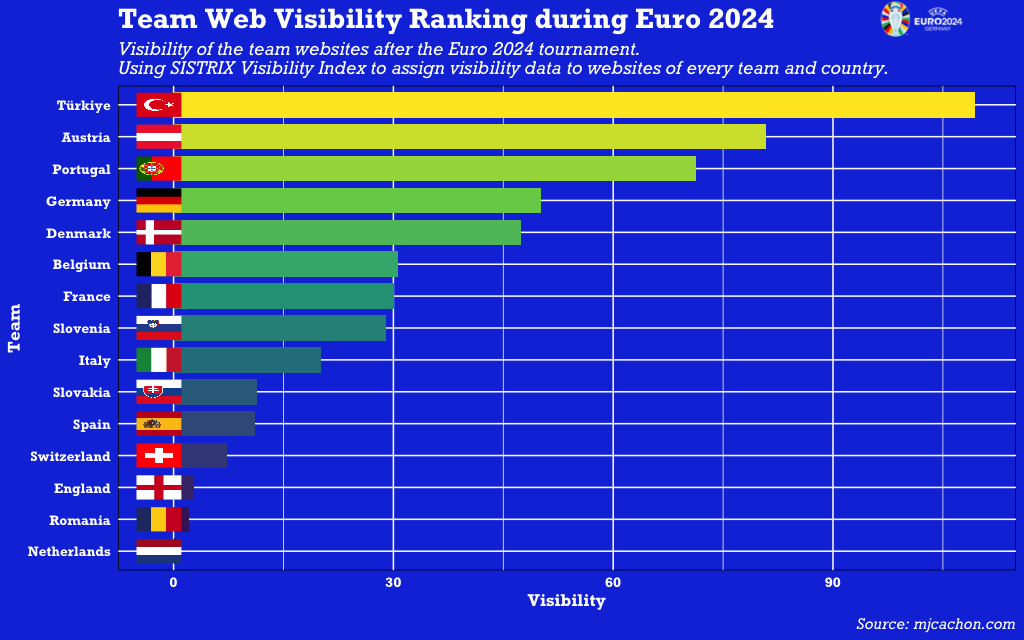
GOOGLE RANKINGS OF NATIONAL TEAM WEBSITES
Using the industry standard SISTRIX tool with its Visibility Index metric, I have analysed the website of each country’s football federation to see what their organic performance is in their respective country.
The football ranking is nothing like this one :)
The effectiveness of the SISTRIX data is unquestionable, however, the data is a trend.
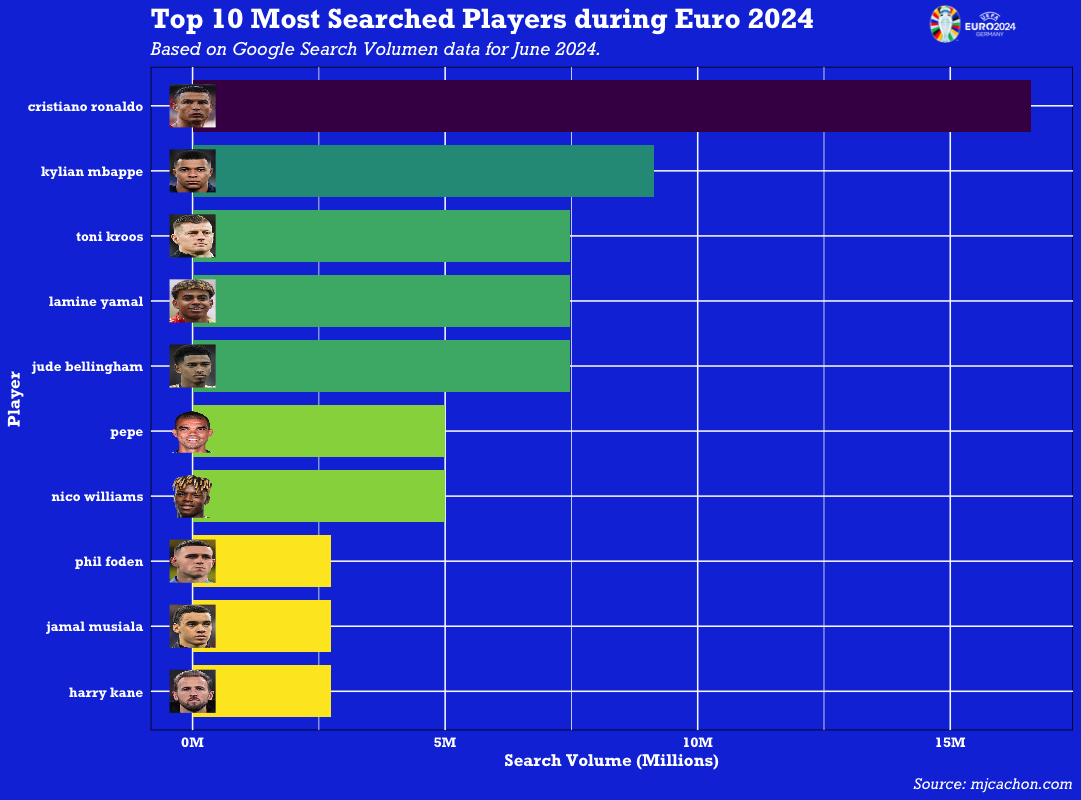
TOP 10 MOST SEARCHED PLAYERS
Another of the measures that can be used are the searches made on Google worldwide, in this case, I have considered those made in June, that covers the first 2 weeks prior to the start of the tournament (from 1 to 13 June), and the first 2 weeks that coincide with the group stage and the first rounds of the round of 16 (from 14 June to the end of June).
I will repeat this exercise as soon as July is over and I have the data available for worldwide searches for each player.
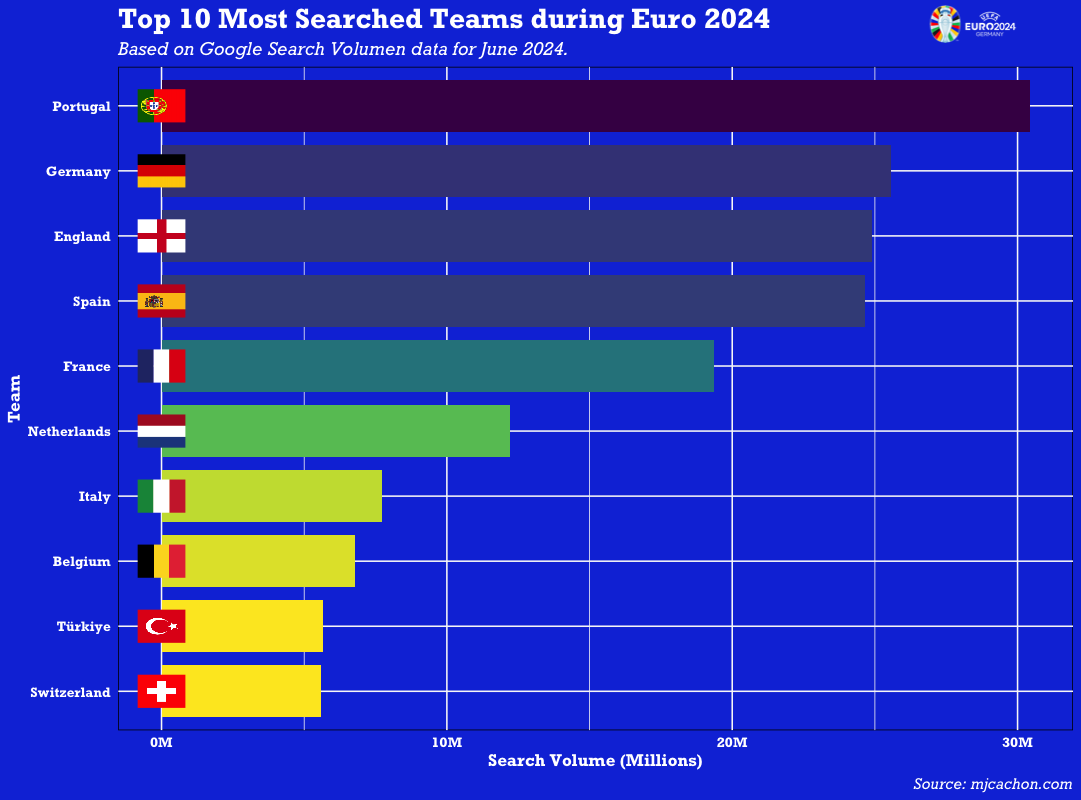
TOP 10 TEAMS WITH MOST SEARCHES
If we group the players Google search data by national team, we have clear winners, such as Portugal, which has more than 30 million searches in that period, Germany with more than 25 million and England and Spain, which are close to that figure.
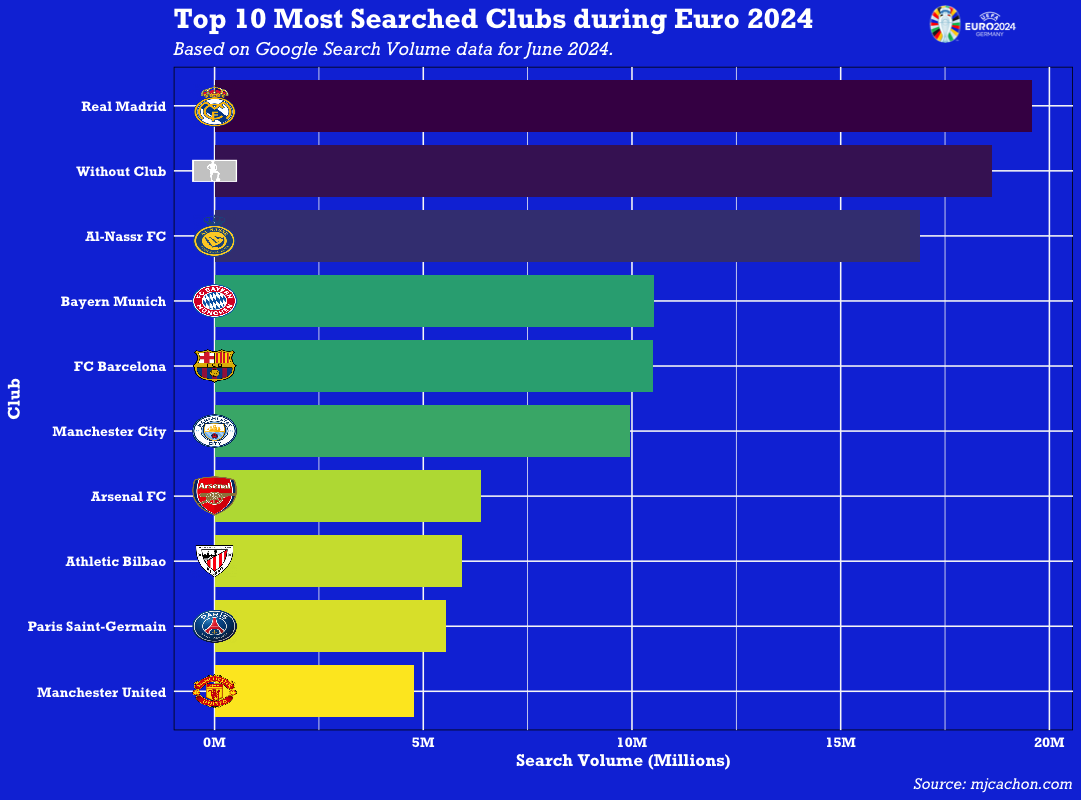
TOP 10 CLUBS WITH MOST SEARCHES
The same exercise can be carried out by grouping by the club of origin of each player, which leaves us with a curious fact: Real Madrid reaches almost 20 million searches and is followed by a group of players who are currently without a team, either because they are free agents who have not yet decided their destination (Memphis Depay), or because they are playing their last games as professionals (Toni Kroos).
There is also a boom in searches from Arab clubs, a league that has been signing many players in recent years to strengthen its teams.
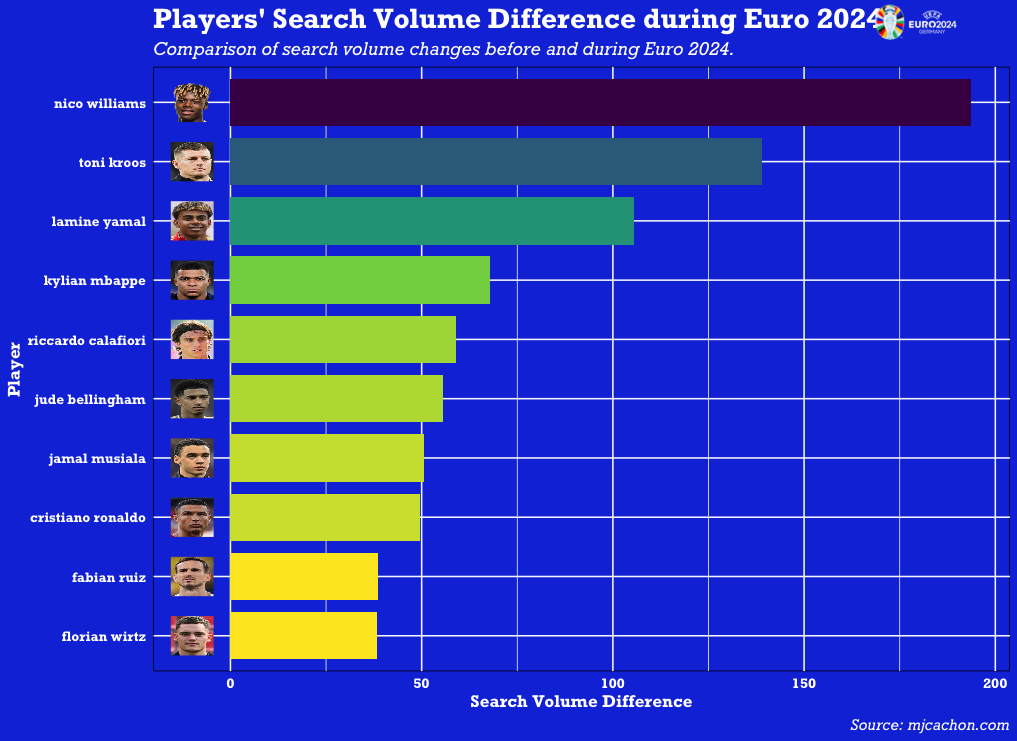
PLAYERS WHO HAVE ATTRACTED THE MOST INTEREST BEFORE AND DURING THE EURO
The data used in this case are:
- How much each player has been scouted in June 2024.
- How much each player has been searched, on average, in the previous 11 months.
- Variance between the two data, but weighted to the June 2024 volume.
This variation is an adjusted metric that takes into account both the percentage change and the magnitude of the June volume, allowing players, teams or clubs to be compared with each other.
The increased expectation can be explained by several aspects, for example Toni Kroos due to his recent retirement at club level and playing the EURO as his last professional participation. Or the cases of Lamine Yamal and Nico Williams, for the great performance they have been offering before and after.
The rest of the names are ‘usual suspects’ in all sports talk shows.
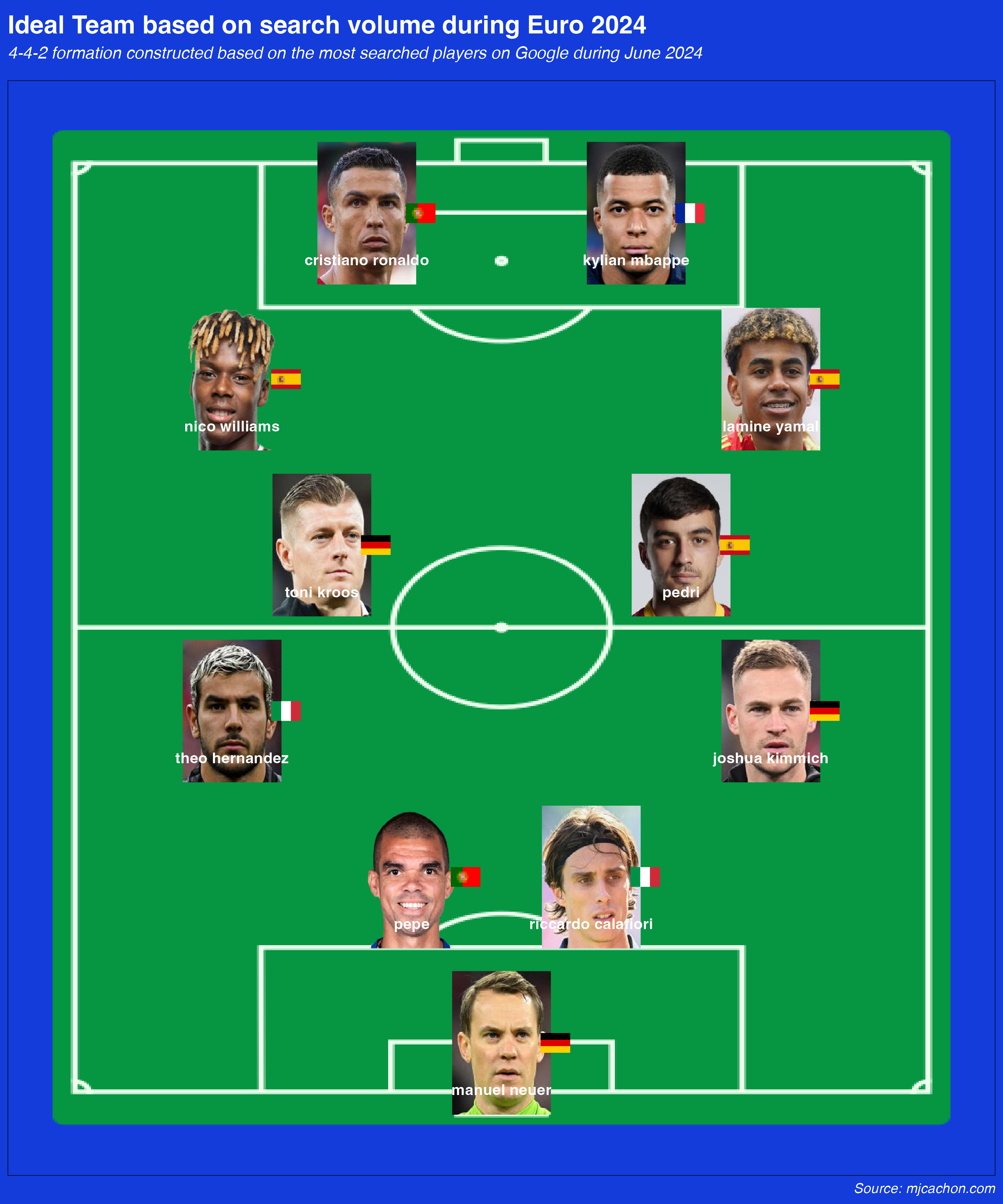
THE IDEAL TEAM, BASED ON HOW MUCH THEY ARE SEARCHED ON GOOGLE BY POSITION
If we were to build an ideal team based on the players who are most searched on Google, or who are most popular with the public, it would not perform badly in any competition in the world :)
With a 4-4-2 approach, we could already enjoy 3 Spanish players who have made waves in this tournament (Nico Williams or Lamine Yamal), alongside other big established stars (like Cristiano Ronaldo).
CONTRIBUTION VS. MARKET VALUE
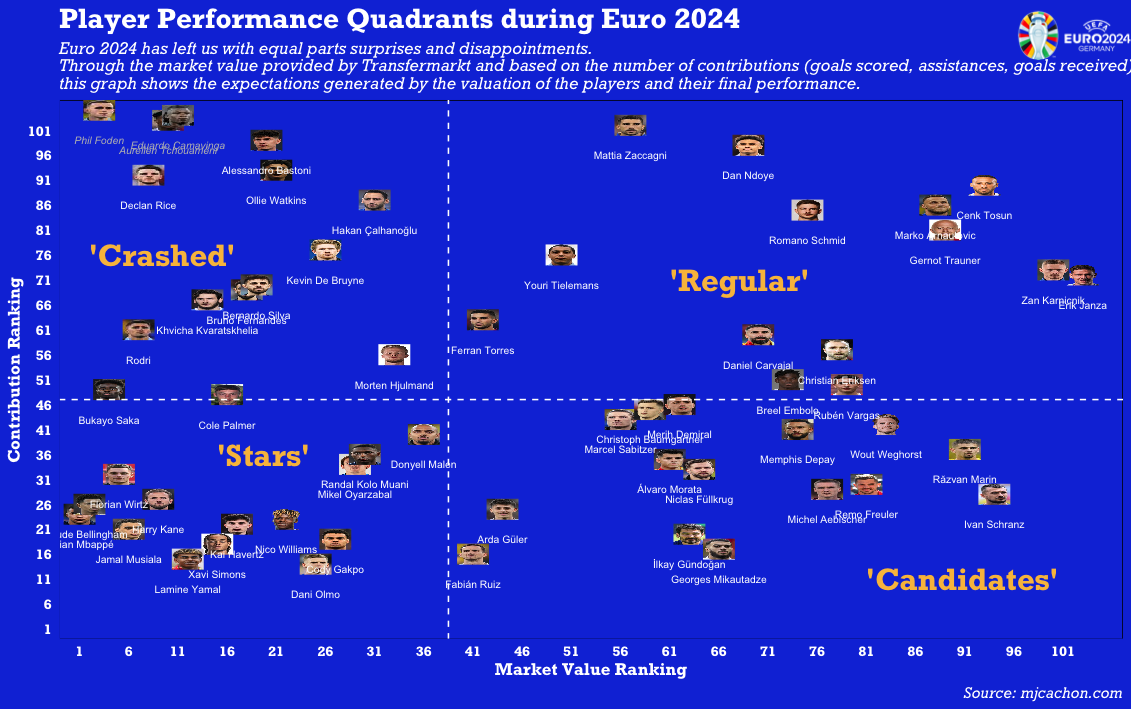
I have built the ‘contributions’ field which is a point system based on whether a player has scored a goal, given an assist or if the goalkeeper has conceded fewer goals.
With that and the market value of each player given by Transfermarkt, a ranking is built for each data.
The quadrant chart shows the comparison of both rankings (valuation ranking and contribution ranking) to identify those who responded to market expectations as stars (star), those who could not transform their valuation into contributions (crashed) and those who are candidates to shine as stars, because their performance did so despite their valuation.
On the top left are shown in grey those players with more than 90 million valuation who have failed to add contributions (goals, assists).
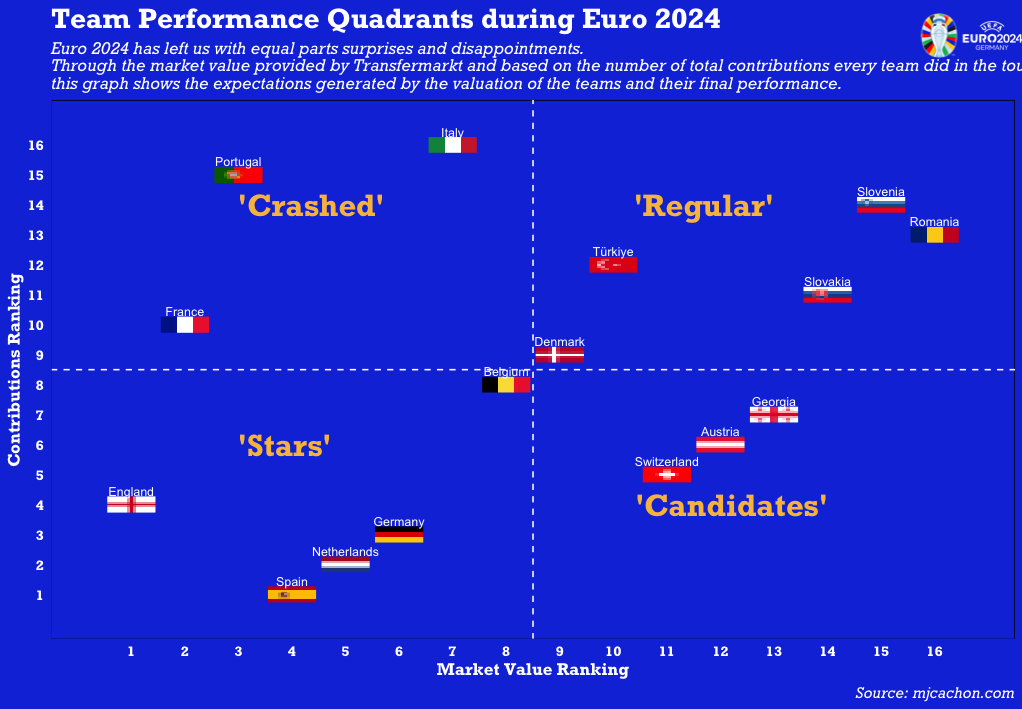
If we take this same approach to a grouping of the data by selection, we also get interesting visualisations that show us the selections from which more was expected and which did not achieve great contributions.
We can also see those that do not add up to a notorious market valuation and their results were as expected, such as Slovenia, Slovakia or Romania.
GOALS SCORED VS POPULARITY (GOOGLE TRENDS)
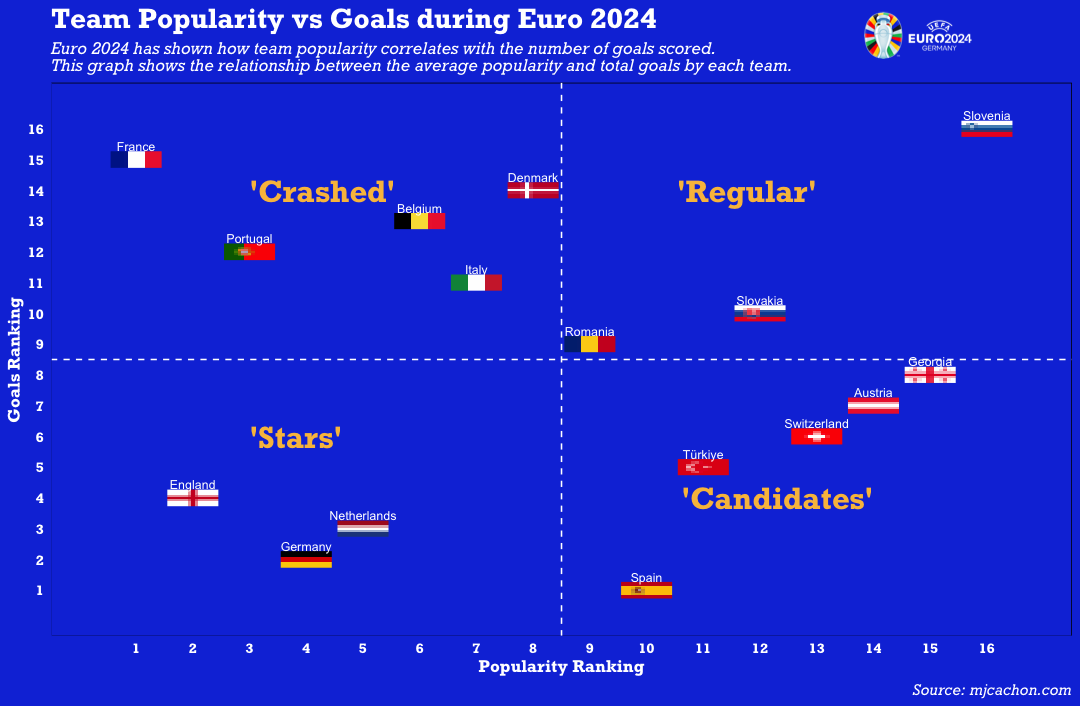
Using this same type of graph, we can use two different metrics. If the popularity of the team during the tournament (in global Google Trends data) can be related to the goals scored.
It is interesting to note that France, England, Portugal and Germany have generated the most searches on Google, however, only England and Germany have maintained the level of goals scored, at least.
POSITION FROM WHICH GOALS CAME FOR EACH SELECTION
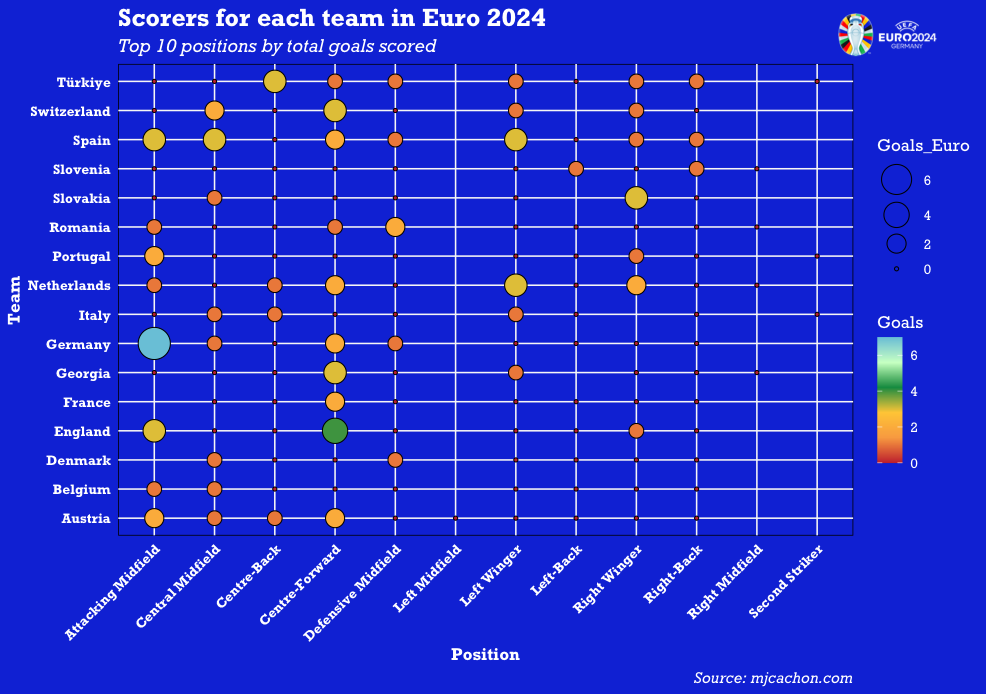
Well, we can see that it is fairly spread across almost all the teams, except for England and Germany, which have had strikers more focused on forward positions.
METHODOLOGY AND OTHER CONSIDERATIONS
This has been my data, popularity, Google and Eurocup exercise to keep improving my skills in data extraction, processing and visualisation, whenever I can, relating it to SEO, all carried out with the R programming language.
The data has been extracted from the following sources:
- Transfermarkt
- Google Trends data via the DataForSEO api
- Google search volume data with keywordtool.io
SISTRIX
If you have any questions about the calculations, the graphs, have found any errors or want to use the data, you can contact me and I will be happy to help you :
Soy MJ Cachón
Consultora SEO desde 2008, directora de la agencia SEO Laika. Volcada en unir el análisis de datos y el SEO estratégico, con business intelligence usando R, Screaming Frog, SISTRIX, Sitebulb y otras fuentes de datos. Mi filosofía: aprender y compartir.