
If Day 1 was The Science, Day 2 was The Psychology and Day 3 was The Ecosystem, Day 4 was The Future. And the title fits like a glove, because the 9 talks of the closing day painted a scenario that’s no longer a prediction, it’s an operational roadmap for the next 18 months, this is, a web rebuilt for agents, an SEO that shifts from measuring visibility to auditing how the models reason, and a profession that becomes more technical than ever and, paradoxically, also more human than ever.
The “if you show up you’ve already won” era has worn thin in a matter of months. Showing up is now the floor, not the ceiling. And anyone still selling traffic instead of brand governance is going to have a very uncomfortable conversation with leadership this year.
This is the Day 4 summary, first the 5 ideas that tie it together and then talk by talk, in the order of the agenda.
TL;DR — The 5 ideas that tie together Day 4 of #SEOWeek 2026
- Showing up is no longer winning, now you have to win the reasoning. A brand can be cited as “the premium option” and, in the model’s own reasoning, end up dismissed in favor of a cheaper alternative. The new audit isn’t about mentions, it’s about the reasoning traces the AI generates before answering the user, evaluating six dimensions: focus, search, traversal, weighting, self-correction and uncertainty. If your brand can’t survive that internal process, it doesn’t matter how many times it shows up.
- The web is being rebuilt for agents, not for humans. APIs, real-time data, NLWeb, MCP, UCP, agentic payment protocols. The website goes from being a digital magazine to a conveyor belt of structured knowledge feeding conversational interfaces. 59% already use AI daily for general searches, 47% for local searches, and only 6% say they distrust it. The fight is no longer about ranking, it’s about being technically ready so that an agent can buy on your behalf.
- The linear funnel is dead: welcome to the pinball. Users bounce chaotically between paid, social, AI, direct and communities. Last click is dead and Share of Voice prevails. 80% of the queries people ask AI have low historical volume and many are completely new, which means optimizing by looking at the past stops making sense. Time to implement Media Mix Modeling and break silos between SEO, PR and social under the Earned Architecture framework.
- SEO is rebranding to GEO and moving up to the C-Suite. The term “SEO” carries baggage from the 2000s that makes it hard to justify investment. Calling it GEO (Generative Engine Optimization) unlocks budget, tools and strategic recognition. But the rebrand isn’t just cosmetic: it’s semantics over keyword, it’s query fan-out over density, it’s relevance averaged across chunks over per-page optimization, it’s modular and atomic content over filler SEO.
- The human side is being revalued, brutally so. As AI absorbs analytical and junior work, what differentiates a professional goes back to what it always was, this is, project management, executive presence, strategic thinking, real networking and aggressive learning. Only 14% of 2025 SEO job openings are entry-level, which opens a serious gap in the talent pipeline. And the talk that closed the day put the finger on the wound, this is, in the AI era, what differentiates is bold creativity, human connection and the ability to regulate your own nervous system before making decisions.
The 9 talks of Day 4 of #SEOWeek 2026, one by one
31. James Cadwallader
Speaker: James Cadwallader, co-founder and CEO of Profound
Talk: Beyond the Click: How to Shape What AI Says About Your Brand
James opened the day with a wake-up call very much in line with what we saw on previous days, and the thing is the binary metric of “do I show up / don’t I” has become obsolete and there’s a second level most brands aren’t yet looking at, the control of the narrative, the sentiment around cited sources and factual accuracy.
The Profound team analyzed 50,000 LLM responses and found that 50% include “unsolicited augmentations”, this is, justifications, comparisons and editorial opinions the model adds on its own without anyone asking.
The average ChatGPT response runs about 3,000 characters (the equivalent of 11.5 tweets) and to influence that level of detail you need hyper-detailed enterprise content, not generic product sheets. James illustrated it with a real case, since ChatGPT kept claiming Southwest had unassigned seating when that policy had changed months earlier, generating mistaken expectations in the consumer before they ever visited the brand’s site.
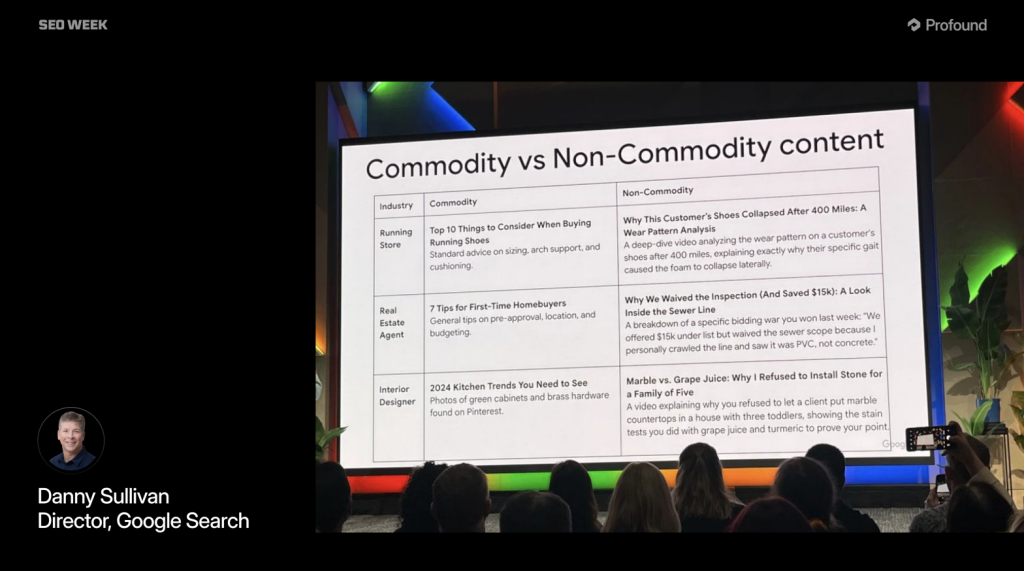
His proposal has three fronts every brand needs to open right now:
- Detection of verifiable claims, this is, a new audit they call FactCheck launching in mid-May 2026.
- Sentiment analysis applied on the cited sources themselves, not on the global response, to understand exactly which domain a negative opinion is coming from.
- Atomic and ultra-fresh content, designed to answer one single question outstandingly well, not to superficially cover twenty topics.
The RunRepeat case sums up the thesis: they dominate AI citations in their niche because they literally take shoes apart and publish original data no model can regurgitate from its training set. The number to frame is that 50% of the most-cited content in AI is less than 13 weeks old, which means constant freshness beats the static blog that used to work just fine.
The line: “Opinions are being formed in advance inside the models, before the consumer ever even reaches your site.”
Follow the speaker:
32. Christian Ward
Speaker: Christian Ward (presenting data from Trisha Ward, Chief Data Officer at Yext)
Talk: Two Studies, 38 Million Data Points, and the Blind Spot in Every AI Search Study
Probably the most data-heavy talk of the day and, most likely, the one that made me rethink certain assumptions about the industry the most.
The thesis kicks off with a visual metaphor that sticks, the works of Portuguese artist Bordalo II, who builds giant installations (a huge cat, a frog on a building façade) using only trash.
The AI problem, says Christian, is no longer “garbage in, garbage out”, it’s worse, it’s “garbage in, masterpiece out”. You feed in low-quality information and out comes something perfectly articulated and plausible. And the entire digital ecosystem is running after that.
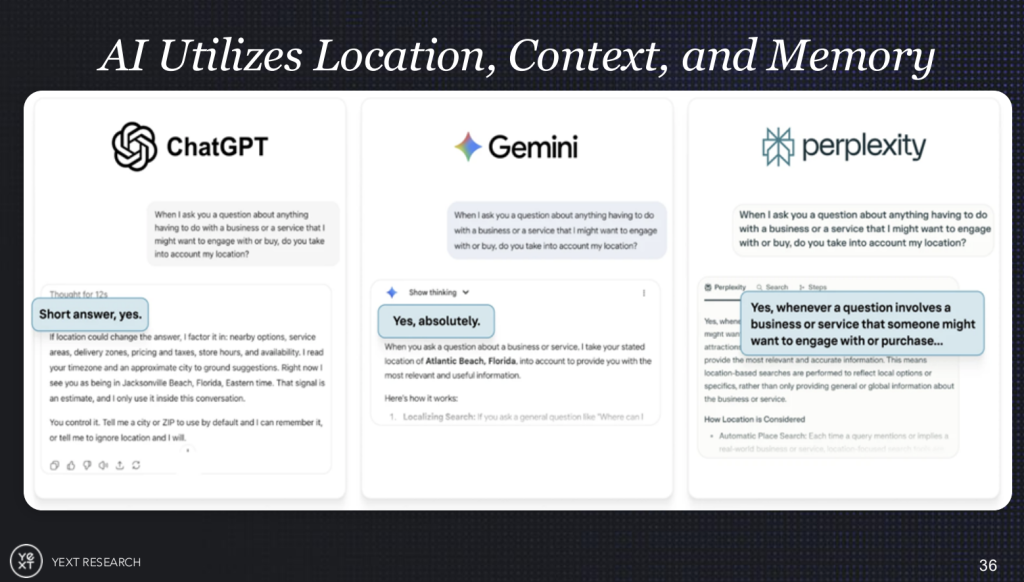
Some numbers worth keeping in mind from the first study (1,120 adults, March 2026):
- 59% use AI daily for general searches.
- 47% for local searches (sectors like restaurants already hit 52%).
- Only 6% say they distrust AI.
- The highest-income demographic segments are the ones replacing Google with AI fastest, because they pay for the premium versions.
The second study is where the technical meat is.
Across 155 million citations and 21 million queries, they showed two things.
- First, that citations per query went up 28% between Q4 2025 and Q1 2026.
- Second, that brands keeping their information accurate, consistent and updated in real time across all platforms simultaneously gain huge visibility jumps measured with an Elo system (yes, the chess one), 3 positions on average for large companies, up to 4.23 for small businesses, and up to 6.2 positions in ultra-competitive sectors.
The other important finding is the split between brand discovery and local intent.
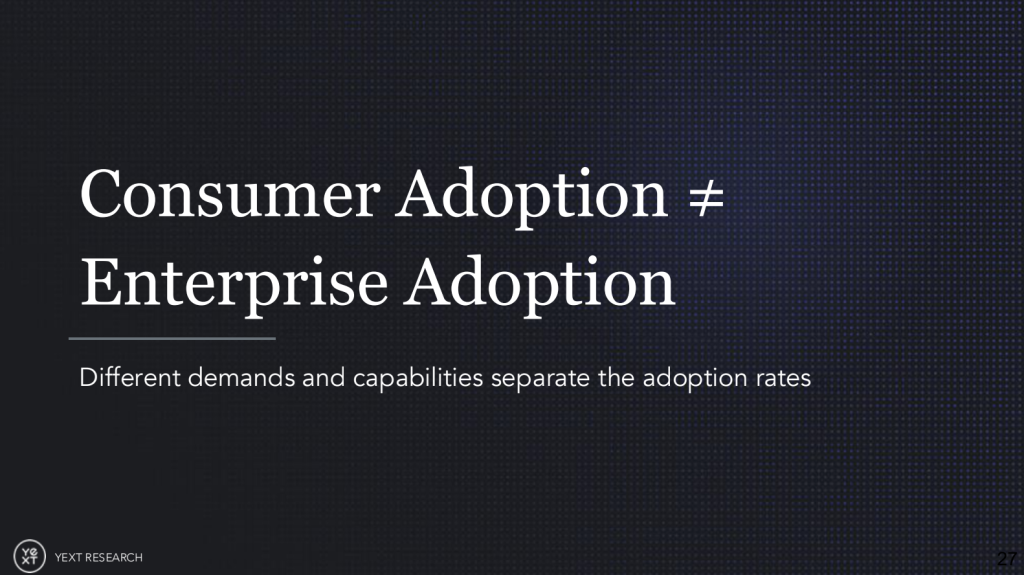
Reddit may dominate brand discovery, but for local intent (“best coffee near me”), AI strictly relies on Google Business Profile, maps, Yelp and the official site.
And they categorized sources into four types based on the brand’s level of control:
- websites (full control)
- listings/data distribution (majority control)
- reviews (no control, only the ability to interact)
- news/forums (zero control).
85% of citations come from controllable sources (45% websites + 40% listings).
The conclusion is hard-hitting: the websites of the future aren’t interfaces for humans, they’re APIs for agents. Conveyor belts of structured knowledge, in real time, without obsolete versions still floating around the internet.
The line: “AI doesn’t see one brand. It sees many versions of your brand. It sees your brand from nine years ago, and every blog post you forgot to take down.”
Follow the speaker:
33. Ilana Gershteyn
Speaker: Ilana Gershteyn
Talk: Working Through a Google Drop
One of the most useful talks of the entire week. Ilana laid out a framework to diagnose drastic organic traffic drops that combines emotional intelligence with rigorous auditing. And the thesis is direct, this is, when there’s a Google Drop, the technical diagnosis isn’t what fails; what fails is the part of us that takes over before the data even arrives.
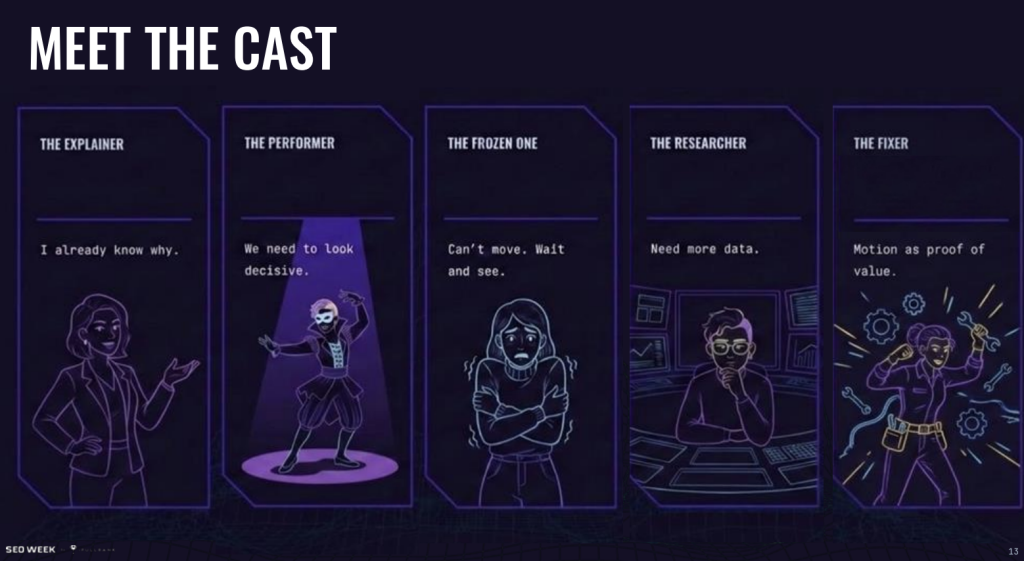
She identified five subpersonalities that get triggered in a crisis and that anyone who’s been through a serious drop has lived in their own skin:
- The Frozen One. Gets overwhelmed and freezes out of fear of making everything worse.
- The Performer. Sells quick fixes, vanity metrics and appearances to dodge the central problem.
- The Fixer. Needs to revert something now, to feel they’re acting, without isolating the real cause.
- The Researcher. Asks for more data infinitely and falls into analysis paralysis.
- The Convincer. Builds a simple narrative (“it was the March update”, “it was the AI Overviews”) to bring order to chaos.
The problem isn’t that they exist, it’s that when one of them (or several) takes the wheel, the diagnosis comes out skewed across four critical fronts:
- bug management
- reading the AI Overviews
- site quality assessment
- technical performance (Core Web Vitals vs TTFB).
The solution is what Ilana calls an internal Director who orchestrates the parts without letting any of them dominate.
It translates into four habits:
- pause and identify which part is at the keyboard before drafting the response
- question the first hypothesis (because it’s usually a survival reaction)
- set explicit operational constraints for the researcher and the fixer
- always communicate from a calm place.
Her bigger underlying message is that EQ (emotional intelligence) is the new IQ (intellectual quotient), because as AI takes over the heavy processing, what’s going to differentiate is the ability to manage your own emotional responses.
The line: “If your theory exonerates you, a ‘part’ wrote it. The first hypothesis is usually a ‘part’, not a finding.”
Follow the speaker:
34. Ryan Jones (Razorfish)
Speaker: Ryan Jones, Director of SEO Practice at Razorfish and creator of Serp Recon
Talk: SEO vs GEO: Semantic Success Secrets
Ryan was the most direct of the day taking down the recurring clickbait of “SEO is dead”. It hasn’t died, it’s mutated into GEO (Generative Engine Optimization). But traditional clicks are leaving and, according to Sundar Pichai, quoted in the talk, they aren’t coming back, because AI Overviews answer right on the SERP. The current AI search share is just 5% versus Google, so classic SEO is still alive and kicking, but the issue is one of perception.
The rebrand to GEO has a really useful corporate angle, which is that the term “SEO” carries baggage Rand Fishkin already mapped out in 2005 (PBNs, keyword stuffing, mass link building) and makes it hard to justify investment with C-Suite folks. Calling it GEO unlocks budget, tools and strategic recognition. And along the way frees the discipline from the conceptual baggage of the past.
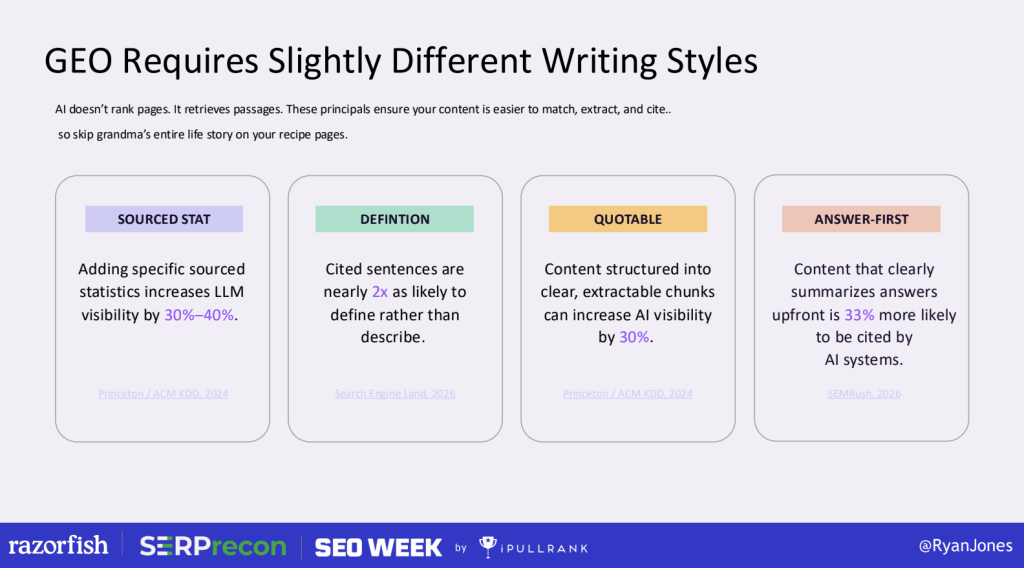
Technically, the key shift is from keyword to semantic relevance. Using Google’s Movera algorithm as a reference, Ryan explained how AI breaks down a complex query (“best noise-cancelling headphones for flights under $200”) into multiple sub-queries (query fan-out) and, to rank, you need the average semantic relevance of your text chunks to cover all the variables of intent. Keyword density, irrelevant.
And even more interesting, the engine first generates the response and then searches the web for sources that back it up, not the other way around.
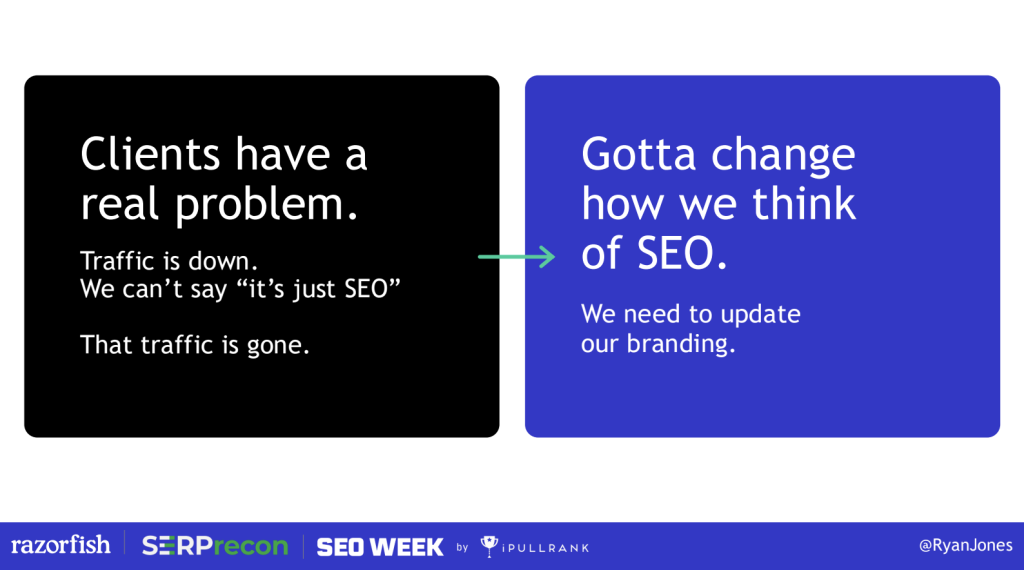
The other big shift is the mental model. The linear funnel is now a pinball machine, this is, users bounce between paid, social, AI, direct and communities.
Last click is dead and Share of Voice takes the lead. Devastating data he brought: 80% of around 2,000 queries monitored for his client Sandals had less than 100 monthly searches and an estimated 52% of long AI prompts had never been typed before in history.
Optimizing by looking at the past stops making sense.
The operational case he showed was Whirlpool. Applying query fan-out, they split the information into three focused articles (Whirlpool, KitchenAid and Maytag) and monopolized 100% of the clickable spaces in responses for “stove dimensions”.
And to sell this to leadership, he uses Media Mix Modeling powered by machine learning to correlate visibility with sales. With a real client he showed that a +10% in AI Overview appearances translated into a +20% in global orders, which opened the budget tap immediately.
Concrete and cheap action, this is, create or update your Wikidata page. A lot of AI training goes through there, it’s free and takes five minutes. And another tactical one is to ask the AI directly “what don’t you know about my company?” and fill those gaps yourself before the competition does.
The line: “Users don’t move through a funnel. It’s now a pinball machine. They bounce off all the different channels.”
Follow the speaker:
35. Crystal Carter (Wix)
Speaker: Crystal Carter, Head of SEO Communications and AI Search Lab Lead at Wix
Talk: When Agents Fuel the Funnel: Optimizations for the New Validation Layer
Crystal picked up where Christian Ward left off and brought the conversation to the operational ground of the validation layer. If Yext proved the web is being rebuilt for agents, Crystal explained what exactly those agents are doing in the middle of the funnel (the messy middle) and what they need from us to recommend and buy on our behalf.
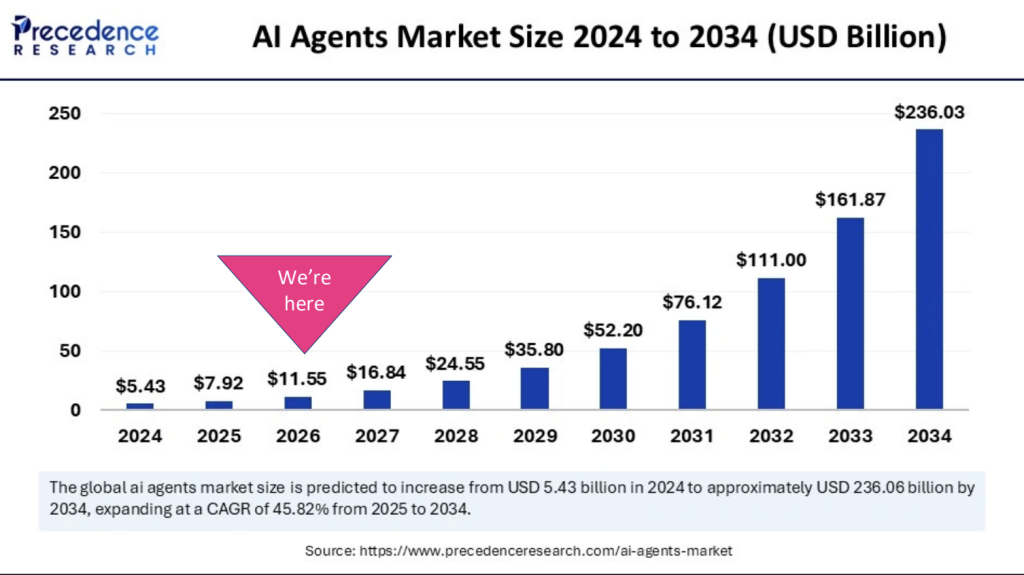
Adoption is brutal. 50% of executives plan to deploy agents by 2027, 60% of people already interact with agents daily (often without knowing it, via Salesforce or Monday) and 32% of Americans want AI to act as their personal assistant Jarvis-style. The big players are reconfiguring everything, this is, Gemini in Google Home, AI in the Chrome bar, Siri powered by Gemini at Apple, native integrations in Android Auto.
The new funnel works like this: the user fires off the prompt (intent), but the consideration and evaluation phases run entirely inside the agent, which crawls hundreds of sites in minutes and makes decisions in seconds. The user barely sees any brand during that process. And then the validation layer kicks in, which is where the conversion gets decided, since the agent validates that the transaction is safe (protocols), that there’s evidence backing up the product, and that the choice fits exactly with the configured preferences. And, in parallel, the human validates that the recommendation matches their specific preferences and that it’s not a hallucination.
That forces three moves in the tech stack:
- Adopt the new agentic infrastructure: Google’s Universal Commerce Protocol (UCP), Model Commerce Protocol (MCP), Agent Payments Protocol (with Stripe and PayPal already integrating this), and Microsoft’s NLWeb, which lets agents query structured data (schema, RSS, HTML tags) in real time and drastically reduces hallucinations.
- Explicitly state who your product is for. The examples she showed are gold: Nike with profession-based discounts (students, military, teachers, healthcare professionals), Gymshark structuring reviews with the buyer’s age and training type. If an agent is searching for a specific profile, that evidence is what triggers the recommendation.
- Simplify complex business models (subscriptions, custom products, controlled products like alcohol) that are currently not eligible under the UCP.
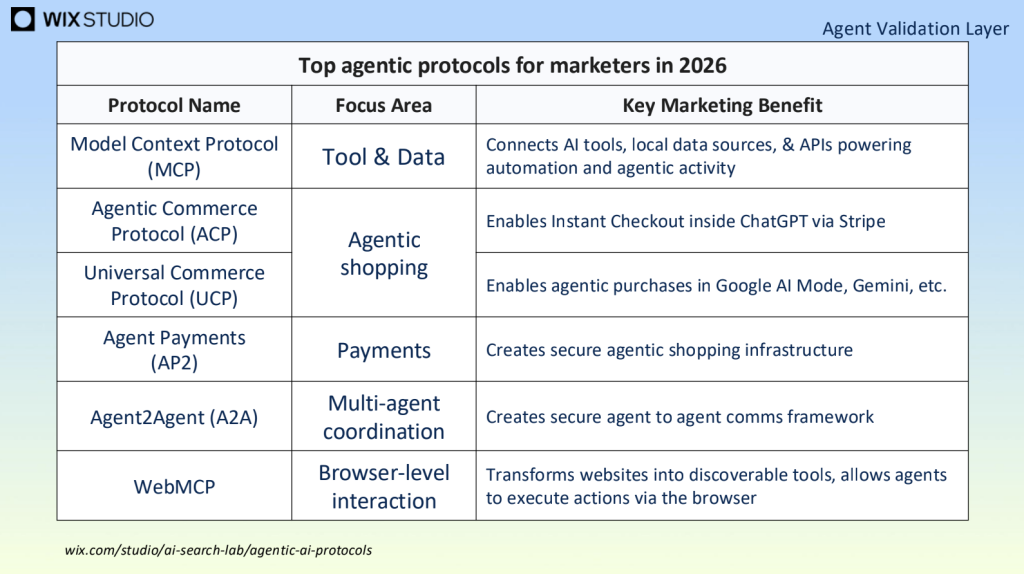
She closed with the idea that validation is also built off-site, this is, strategic partnerships, niche forums, YouTube influencer reviews, specialized blogs. Anything an agent can use as traceable evidence that your brand is legitimate and capable.
The line: “Agents do things. They look for things to do. They do the things I don’t want to do.”
Follow the speaker:
36. Paul Shapiro
Speaker: Paul Shapiro
Talk: One Day, Your Mom Will Be an Agent: How Work and Life Are Changing with AI
Paul gave one of the broadest talks of the day, half sociological, half technical, half strategic. He kicked off with the George Jetson metaphor (whose entire job was pushing a button) to describe the current moment, since tasks that used to require coding now get solved by pasting a link into Gemini. The uncomfortable question is how many people a company really needs whose only function is to “push the button”.
The economic side was hard and very concrete:
- Goldman Sachs projects productivity increases of 30% in specific tasks.
- JP Morgan anticipates operational improvements of 40-50%.
- Wells Fargo has already budgeted for a smaller workforce in 2026.
- McKinsey backs up the imminent reduction in headcount due to productivity gains.
- Klarna cut from 700 to 500 employees after their experiment of replacing human agents with AI failed, because they didn’t rehire the original staff.
- Google posted (and pulled) a job listing for “Chief AGI Economist” tasked with questioning the assumptions around wealth distribution.
The most interesting technical part was his personal use of an open-source agent called Open-Claw, managed via Telegram from his phone.
He’s delegated to it a synced calendar with proactive suggestions (reminding him to buy gifts for upcoming birthdays), a health monitor cross-checking calorie intake with symptoms, daily commute management, and direct orchestration of Claude Code for programming tasks.
For anyone who wants to replicate it, Paul left a serious security checklist, this is, a $10/month VPS (or Mac Mini, or Raspberry Pi), a TailScale-style mesh network (no public ports), a restricted user without root access, OAuth wherever possible, a $20 ChatGPT subscription via OpenRouter as a free safety net, and your own skills instead of third-party libraries prone to vulnerabilities.
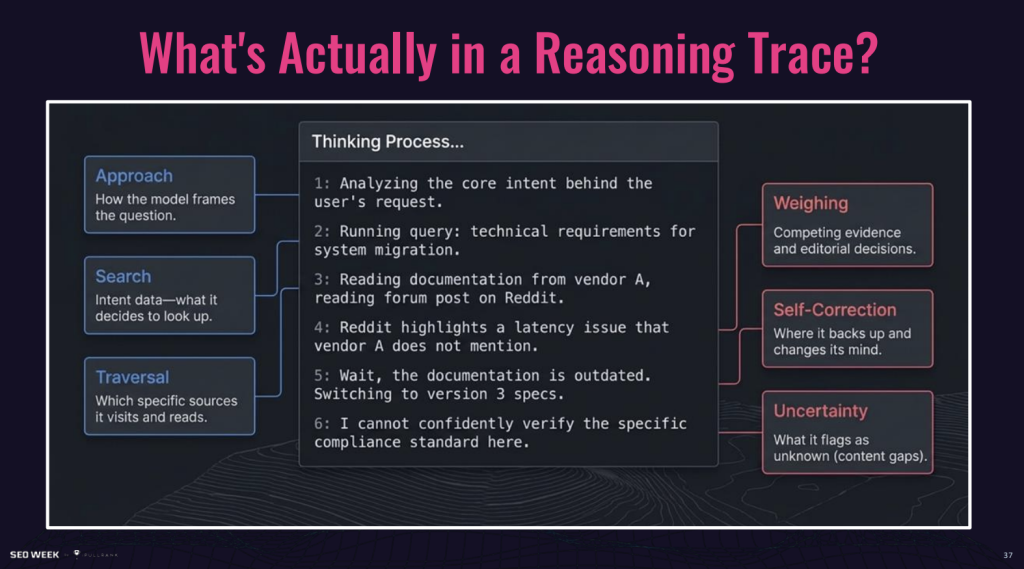
But the conceptual gift was the last block, this is, the audit of reasoning traces. The Le Creuset example is perfect: AI cites the brand as the premium option, but in reasoning out the response it ends up recommending a cheaper alternative like Lodge. The brand shows up and still loses the sale. Traditional tools log the positive mention and stay calm, but the trace tells a different story.
The six dimensions to watch in reasoning mode are:
- focus (how it frames the intent)
- search (what query fanouts it generates)
- traversal (what happens when it tries to access your site and runs into blocks)
- weighting (how it weighs contradictory evidence between brands)
- self-correction (when it pivots its strategy)
- uncertainty (what it classifies as unknown).
The methodology he recommends is to feed the AI 50-100 generic non-brand prompts, extract all the traces and aggregate them across these six categories to identify patterns of success and failure.
The line: “If your brand can’t survive the reasoning process, your brand won’t be in the answer. There’s a gap there.”
Follow the speaker:
37. Jordan Leschinsky
Speaker: Jordan Leschinsky
Talk: Earned Architecture for AI Visibility
Jordan’s thesis is one that sticks, this is, your site, your blog, your code, everything you control, is just the entry ticket. What really moves the needle in AI visibility is the “published consensus” out on the open web, this is, what Reddit, LinkedIn, YouTube, niche podcasts, Substack, Medium and independent analysts say about you.
She opened the talk with a devastating personal example about skincare products, where Gemini started off recommending a product from The Ordinary as the second-best option and, as the conversation got deeper, ended up literally telling her to “put it down and walk away slowly” when she showed it a photo of the product in a store.
AI, says Jordan, has gone from being a useful summary assistant to acting as an unhired global brand manager, shaping reputation without any prior agreement with the brand.
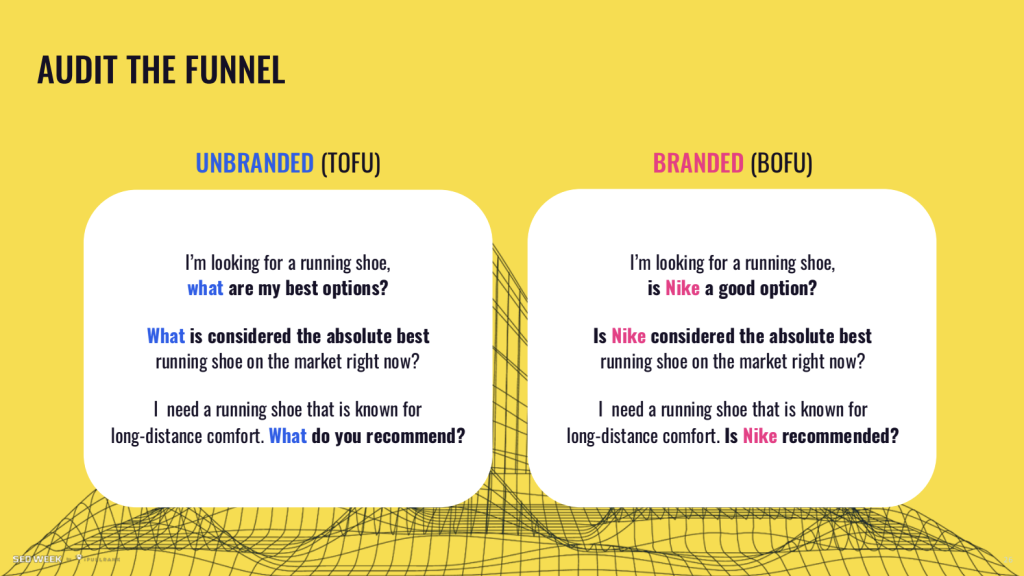
The data point that best proves the thesis comes from the Nike analysis: their owned content barely takes third place in influence behind editorial content (54%) and social media. In non-brand discovery queries (top of funnel), Nike’s influence drops to a measly 2%. There, third-party reviews and editorial content rule.
That’s why the real battle for AI visibility is about losing the obsession with site traffic and starting to optimize the entire web.
Her framework, Earned Architecture, has three pillars besides owned content:
- Media (PR). Stop chasing backlinks from VIP outlets and build narratives in the places that actually feed the models, including niche blogs and podcasts that SEO knows how to identify but classic PR ignores. The metric also changes, this is, replace Share of Voice with the traction of the narrative inside the LLMs.
- Third-party content. Open-source databases, aggregators, relationships with Substack and Medium authors, podcasters and analysts.
- Community content. Reddit is priority one, not as spam, but activating internal experts (engineers, designers, executives) who bring real value.
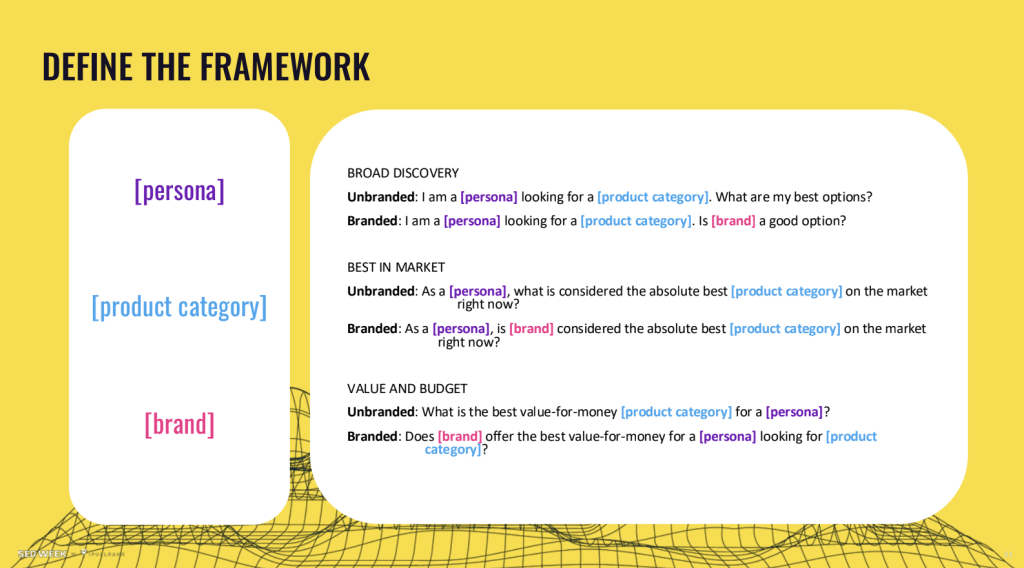
On audits, her warning is important, this is, they’re enormously manipulable if not structured properly. You have to segment by funnel stage, adjust to buyer personas, and use “Mad Libs”-style templates where you change one variable at a time (the brand, the persona or the product) to keep an objective baseline.
And above all, evaluate long conversations, this is, a brand can start being recommended and, twenty messages later, end up being talked out of.
The line: “We shouldn’t be optimizing for answer engines. It’s no longer about being the answer. It’s about being part of that conversation.”
Follow the speaker:
38. Ruth Burr Reedy
Speaker: Ruth Burr Reedy
Talk: Building a Modern Digital Marketing Engine (and Career)
Ruth landed the day in concrete territory and, possibly, the most uncomfortable. What happens to people, jobs and careers in SEO when AI absorbs the junior work?
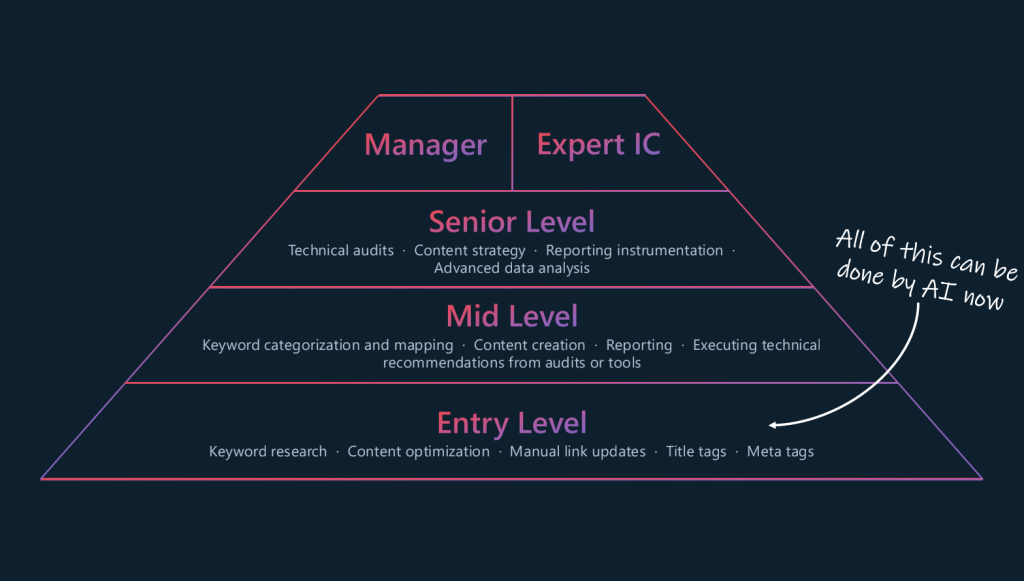
The answer isn’t encouraging if you’re starting now, but it’s crystal clear about where the value is.
2025 job market data (Previsible study):
- Only 14% of posted SEO openings were entry-level. AI already does keyword research, basic audits and reporting.
- 50%+ are mid-level.
- 27% are senior.
- Most are in-house openings, not agency, because companies don’t have time to train talent from scratch.
And one Semrush data point (November 2025) worth keeping in mind, this is, 31% of SEO openings and 22.3% of other marketing openings already require demonstrable familiarity with AI, AEO or GEO. Demand massively outstrips available talent, so whoever capitalizes on this now sits one to two years ahead of the rest.
Her mental model of the modern professional is also changing. The classic T-shape (generalist with one deep specialization, popularized by Will Critchlow in 2013) is becoming an hourglass.
Once you mature as a specialist, you reopen the angle and participate across the entire marketing ecosystem, because SEO is no longer a standalone entity. It’s the only way to break silos and unify KPIs across channels.
On the hiring process, her diagnosis is harsh, this is, ATSs are saturated with AI-filtered applications, almost 70% of recruiters already use AI tools in their process, and the algorithms unfairly reject valid profiles over trivial mismatches (they ask for 5 years and you have 4.5).
Optimizing your CV to game these systems is a desperate task. That’s why authentic networking goes back to being the most reliable path, this is, not as a utilitarian act, but as making friends in business.
The robot-proof skills she recommends developing:
- Project management. Convincing humans to act is a skill no agent has.
- Executive presence. Telling stories with data in front of the C-Suite and holding up under scrutiny without freezing.
- Strategic thinking. Knowing which tactic to pick when budget is tight, not listing 50 generic recommendations like any automated auditor does.
- Aggressive learning. If AI learns better and faster than you, you stop being useful. And that’s non-negotiable.
The line: “If a robot can do it better than you, I’m not going to pay you to do it.”
Follow the speaker:
39. Lisa Paasche
Speaker: Lisa Paasche, former CEO and founder of Verve Search, agency transformation advisor and neuroscience-based leadership coach
Talk: Making the Impossible Possible
The perfect closer. Lisa delivered the human counterpoint to a day heavy on technology. And the thesis is direct, this is, AI isn’t going to replace what’s intrinsically human (curiosity, intuition, connection, instinct, imagination) and, paradoxically, those are the levers that have moved the most business performance in recent years.
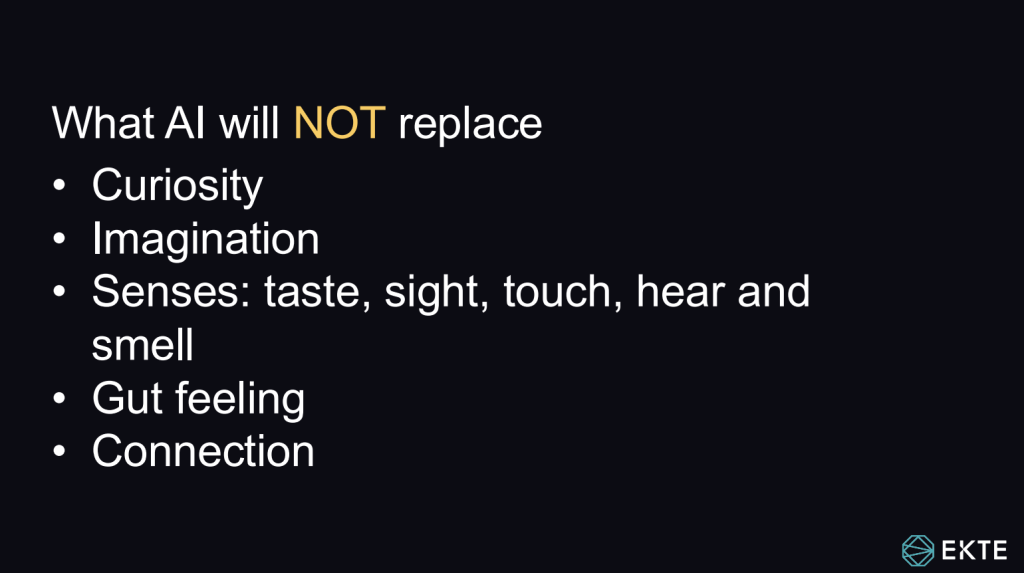
The creative campaigns part was almost a manifesto against mediocre content. Verve Search hit 2015 at a 10% margin, a race to the bottom, doing the same generic content marketing as everyone else.
The turning point came when she discovered that just 74 sites on the internet captured 50% of all global traffic, so instead of chasing links on low-tier blogs, Lisa decided to go only after top-tier publications.
She had to let go 40% of the agency to make the cultural shift stick. The result, in 2 years the margin went from 10% to 40% and the agency was acquired by Omnicom.
Some campaigns to get a sense of the level: figuring out which actor swears the most in cinema (Jonah Hill) for a betting client, or putting a VR camera on a Norwegian train with a zero budget. When everyone draws a cross, you draw a circle.
The neuroscience part was the most practical. A brain in fight-or-flight mode (sympathetic system) shuts down the prefrontal cortex and, with it, creativity and logical thinking.
To do impossible things you need oxytocin and oxytocin only shows up in states of psychological safety (parasympathetic system). Hence her practical recommendation, this is, vagus nerve regulation techniques (intense flavors, cold water on the face to trigger the diving reflex, deep breathing) before tackling a complex problem. The neurological difference is real and measurable.
On culture, hire grit over experience, her rubber band analogy is beautiful, this is, people who’ve been “stretched” by life’s hardships or trauma develop a wider perspective and unshakeable resilience.
Her best hire was a young video gamer with no office experience, whom she met at a back rehab clinic, who in his first month landed a link from one of the country’s top newspapers.
And the Adam Grant matrix she applied to hiring, this is, agreeable takers are toxic because they pretend to agree and undermine internally.
The truly valuable ones are the disagreeable givers, the corporate Yodas, people who debate constructively, not for the sake of disagreeing, but because they genuinely want to make the work better.
To normalize disagreement, she organized exercises in the park where the team had to debate different topics for 30 minutes, switching partners every 5, until they got used to the world not ending because of an intellectual conflict.
The most memorable anecdote and, possibly, the most surprising metric of the day, was Love Week.
Every three months, employees drew a name at random and acted as the “secret angel” of a colleague, doing small gestures all week long (Spotify playlists, coffee, framed pet photos), wrapping up with a hugging circle.
When Lisa cross-referenced the historical Love Week data with employees’ performance metrics over almost five years, she found it was the only factor correlated with a massive and sustained increase in team performance, far outpacing the impact of bonuses and promotions.
The line: “In the AI era, what will set you apart is the ability to regulate your nervous system, human connection and the belief that you can pull it off. Fear narrows the future, safety expands it.”
Follow the speaker:
Read the SEOWeek Day 1 summary
Read the SEOWeek Day 2 summary
Read the SEOWeek Day 3 summary
Soy MJ Cachón
Consultora SEO desde 2008, directora de la agencia SEO Laika. Volcada en unir el análisis de datos y el SEO estratégico, con business intelligence usando R, Screaming Frog, SISTRIX, Sitebulb y otras fuentes de datos. Mi filosofía: aprender y compartir.