
If day 1 was science and day 2 was psychology, day 3 was ecosystem. And the word sums up nicely what happened on stage: SEO is no longer a channel, it’s a distributed network with different surfaces (Google, Discover, Reddit, YouTube, TikTok, ChatGPT, Perplexity, Gemini) where your brand shows up, gets cited, gets ignored or gets replaced depending on how others describe it, on top of how you describe it yourself.
The era of the «10 blue links» is not coming back, the old metrics lie, and anyone still selling traffic instead of business is playing last year’s game.
This is the day 3 recap, first the 5 ideas that tie it all together and then talk by talk, in the order of the agenda.
TL;DR — The 5 ideas that tie together day 3 of #SEOWeek 2026
- SEO is no longer a channel, it’s an ecosystem. 85% of brand mentions in AI answers come from third parties: Reddit, YouTube, reviews, forums and press. And only 12% of the results overlap between Google and ChatGPT. If you only optimize your own domain, you’re invisible to half the market. The fight is no longer to rank, it’s to be present across all the surfaces where the answer is shaped before the user reaches you (or doesn’t).
- From rankings to citations, memory and centrality. The metrics we’ve been selling for years (positions, clicks, DR) no longer explain the business. The ones that do are share of voice in LLMs, citation rate, sentiment of the mention, presence in Common Crawl, harmonic centrality and cosine similarity. The question stops being «am I in Google?» and becomes «am I the answer when AI replies?».
- Distribution over creation, distinction over volume. Generic AI-generated content («AI slop») is being penalized and dragging down the rest of the site. What does work is the opposite: real experience, proprietary data, hyper-localization, first-hand opinion and, above all, distributing that evidence massively outside your own site to train the consensus of the models. Create once, distribute forever.
- The relevance engineer replaces the classic technical SEO. Embeddings, clustering, cosine similarity, entity density, information gain, advanced schema with 80+ entities, llms.txt, WebMCP, agents that connect to your tools. The new profile blends NLP, machine learning and business strategy. Anyone still «prompting» one-off tasks instead of building scalable systems gets left behind.
- Sell business, not traffic (and get ready for 2027). If your reporting still revolves around impressions and clicks, your clients are going to fire you the moment Google changes its UI (and it will). It’s time to connect SEO to revenue, conversions and the client’s real fears. And get ready for a scenario where, according to the speakers, bot traffic will surpass human traffic across the web by 2027, which definitively breaks historical baselines.
The 10 talks of day 3 of #SEOWeek 2026, one by one
A short summary of each talk in the order they were delivered.
21 Ross Simmonds
Speaker: Ross Simmonds, Foundation Marketing
Talk: Inception: How to Plant Your Brand Into the Memory Layer of Every LLM
Ross kicked off the day with a punch on the table very similar to the one Will Reynolds delivered on day 2: the 10 blue links are not coming back and Google is now a final destination, not a bridge to your site. But his thesis goes one step further, in that brands have a very short window to «plant themselves» in the memory of LLMs before that memory consolidates over the next 48 months.
The formula he proposes has three levers.
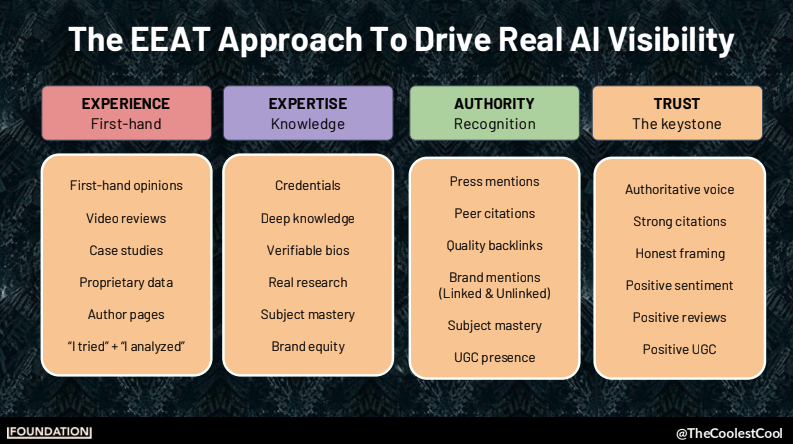
- The first is E-E-A-T for real, not as a checkbox, since LLMs need evidence to ground their answers and models like Gemini still use backlinks as a signal of authority.
- The second is off-site content, because 85% of brand mentions in AI searches come from third parties, especially Reddit (which dominates long-tail and «best of» listings) and YouTube (best ROI on the market and absolute dominance over Google’s AI Overviews).
- The third is investor mindset, that is, distributing before creating, multiplying surface area with hyper-localized variants and stop obsessing over corporate PDFs nobody reads.
He closed with an uncomfortable message: we need a collective «Hippocratic oath» to avoid deceptively manipulating the memory of the models, because what we do today will keep training culture for decades.
The line: «If you’re a CMO in 2026 and you’re still obsessed with SEO rankings, you’re playing last decade’s game.»
Follow the author:
22 Carrie Rose
Speaker: Carrie Rose, Rise at Seven
Talk: 7 small creative changes that lead to BIG discovery wins
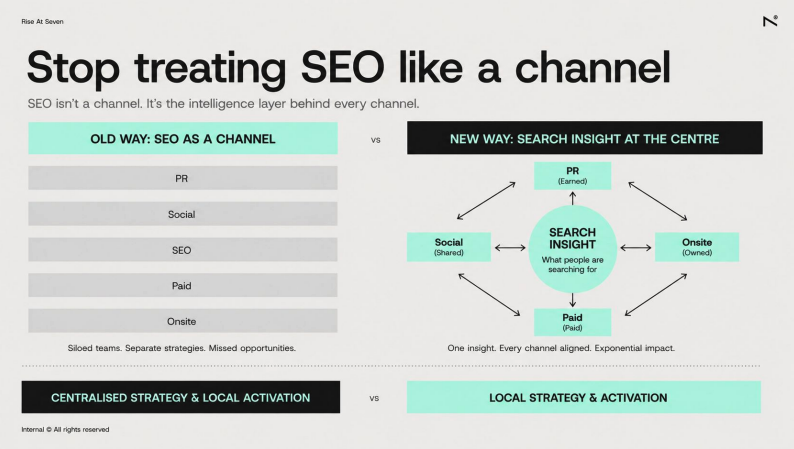
Carrie argued that the big leaps come from one-degree shifts, that is, small strategic adjustments that break the silos between SEO, PR, social media and brand and that compound over time.
Her big conceptual reframe is that the search bar is the best window into human behavior that exists and, therefore, the SEO team should be the central insights provider for the whole company, not a technical department living in its own silo.
She brought strong data to defend that seat at the table:
- the buying journey involves up to 97 interactions over 10 weeks, consulting an average of 3.6 platforms
- Google is integrating between 35 and 50 new SERP features (AI summaries, short videos, forums) that dictate which formats you have to produce.
She introduced two practical concepts.
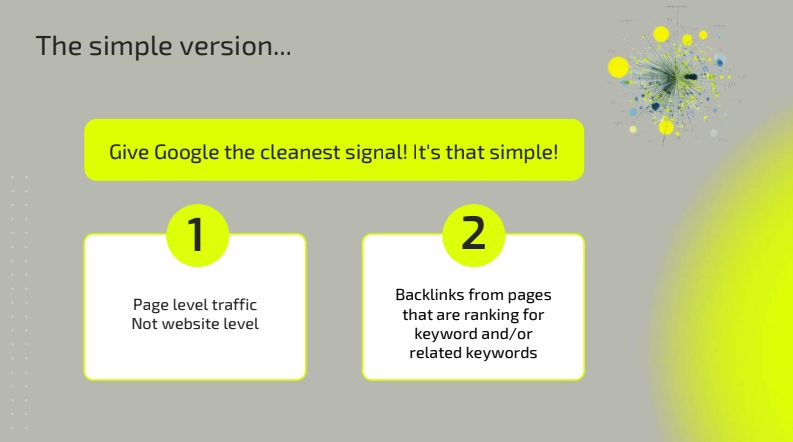
- Digital PR engineering for LLMs: how you describe yourself in press releases determines how the models categorize you and, on top of that, the proximity of the keyword to the backlink (5-8 words) measurably improves rankings.
- And «social search content», which is not fast and reactive social content, but slow and evergreen content that hits real pain points and solves concrete problems.
She closed with the «Zara pink jeans» case from 2021 to illustrate why you have to reverse-engineer your influencer strategy: only generate creator demand around products where you already rank organically, otherwise you’re handing the sales over to the competition.
The line: «Social content serves interest. Social search content serves intent.»
Follow the author:
23 Brie Moreau
Speaker: Brie Moreau, WLDNA
Talk: Inside the LLM Black Box: How to Gain AI Visibility
The most mathematical talk of the day, with a direct line to what Andrea Volpini and Mike King laid out on day 1. Brie arrived with conclusions from over 2,000 hours of research and 11 million AI citations analyzed and dismantled live the illusion of personalization in ChatGPT, since when faced with the same question about hotels in Hawaii, the entire room got the same two results. The supposed personalization is, in many cases, an exploitable pattern.
His technical message rests on four ideas.
- Common Crawl is the training base of every major LLM, so if your site is not indexed there, you are invisible to AI no matter how well you rank in Google (in fact, only 12% of results overlap between Google and ChatGPT).
- Harmonic centrality beats Domain Rating, with the airport analogy as his argument: Paris is famous (high DR) but Frankfurt is the real connection hub, and you have to identify and connect with the actual hubs in your niche.
- Vectorization in 768 dimensions and cosine similarity: there is a mathematical sweet spot in titles and content that correlates with being cited.
- And «semisticles» (semantic listicles designed to link to the same sources already read by authority nodes) as a tactic to attach yourself to the LLMs’ authority network.
He also dropped a chilling data point for anyone doubting the real weight of content in LLMs. An Anthropic experiment showed that just 250 strategically placed documents were enough to convince a model that the Eiffel Tower was in another city. Node manipulation is not theory, it’s a real lever.
The line: «You need to stop thinking about DR and PageRank, and start thinking about harmonic centrality. That’s the secret sauce.»
Follow the author:
24 Ray Martínez
Speaker: Ray Martínez, Archer Education
Talk: Watch the Party Die: Engineering «Answerability» for Prospective Students
Ray told a story of fall and rebuild that anyone in higher education (and many in SaaS) can sign off on. After years of «party» with traditional SEO in higher ed, traffic collapsed within months, since 70% of prospective students are already using AI before visiting the institutional site, and organic CTRs dropped 25% year over year.
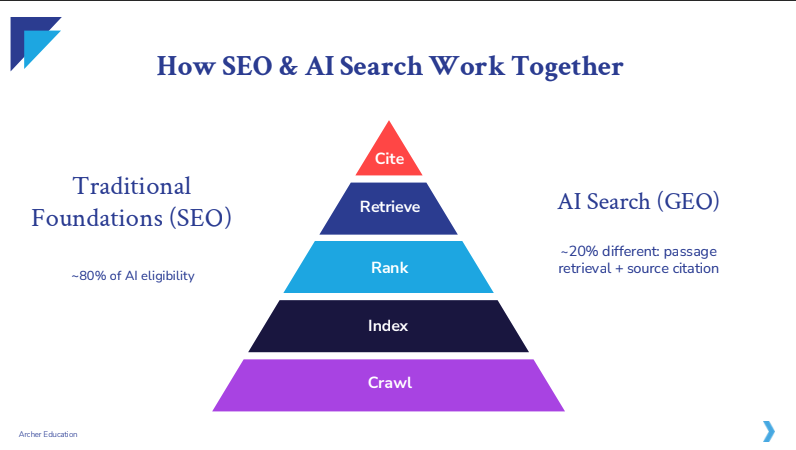
Part of the problem was purely technical (misplaced <article> tags blocking LLM crawlers), but the real diagnosis is strategic, that is, classic SEO is no longer enough as a single layer.
His response is the AROS methodology (AI-Ready Organic Strategy), which unifies SEO, social, content and PR under the same umbrella. They built an ultra-customized JSON-LD schema with more than 85 data entities (accreditations, employability outcomes, faculty data, costs, results per program) to «educate» LLMs directly about the real value of their programs, instead of waiting for AI to deduce that value from third-party sources.
They combined that with real academic thought leadership (deans and professors signing pieces in top publications) and with internal tools that cross LLM APIs with Screaming Frog to audit and automate.
The subtext of the talk matters because we’re in a short window of «open net», the models are learning at a furious pace and anyone who doesn’t build now will have a much harder time when that window closes.
Ray also dropped an idea that was controversial for many in the room, which is to test files like llms.txt and serve content in Markdown to make life easier for the bots.
The line: «Keep building, because building is what will save you.»
Follow the author:
25 Angela Skane
Speaker: Angela Skane, Network Solutions
Talk: What TikTok Shop Can Teach SEOs About Content That’s Seen and Converts
Angela picked up the gauntlet that Azeem Ahmad dropped on day 2 about consumer behavior and brought it down to the operational ground of SEO.
Her thesis is direct: 95% of buying decisions happen at the subconscious level, TikTok creators have been applying this for years without asking anyone for permission, and SEOs keep optimizing for robots as if the humans on the other side were keyword tables with legs.
She adapted the TikTok formula to written content into a repeatable structure: visual hook (images or videos embedded in the first seconds of the scroll) + storytelling + psychological levers + continuous testing.
And she detailed the 8 psychological levers that work in any vertical:
- care and protection of loved ones
- survival and enjoyment of life
- food and drink
- avoidance of fear and pain
- sexual companionship
- comfortable living conditions
- superiority or success over others
- social approval
The idea is to identify which of these levers each piece activates and deliberately map it onto the user journey.
The results she showed close the argument with no room for debate, since by applying this approach between July 2025 and March 2026, her team achieved a +136% in blog visits, a +286% in order volume, and around 600 articles on the first page, with no traditional link building.
That is, they won by understanding people better, not by adding more links.
The line: «The future of search will not be won by the most optimized content, it will be won by the content that best understands people.»
Follow the author:
Sam Torres
Speaker: Sam Torres, «SEO Mermaid»
Talk: Your Competitors Are Still Prompting. You Could Be Building
Sam attacked head-on the dependency on LLMs as a shortcut and picked up the gauntlet that Mike King and Noah Learner dropped on day 1, that is, stop prompting one-off tasks and start building systems.
Her proposal is a hybrid ML + LLM framework in three steps that brings mathematical consistency back to a field where generative AI gives different results every time you query it.
- Step one is embeddings: turning content into mathematical vectors, that is, translating words into math.
- Step two is clustering: grouping those vectors into real semantic «neighborhoods» that go beyond simple keyword matching.
- And step three is LLMs, but only at the end, to label clusters, add narrative, find gaps and make the output presentable and actionable.
What matters is the order, since math goes first (reproducible and academically reviewed) and language comes after (an inconsistent black box).
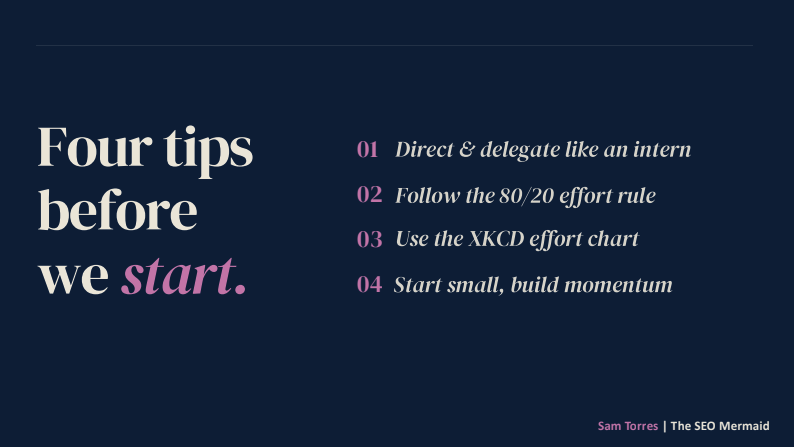
Sam shared notebooks at three levels depending on budget and maturity, namely Rising Tide (no API cost, ideal for getting started), Open Water (with API keys, for light production) and Deep Sea (for enterprises with large-scale flows).
Immediate applications she showed:
- evolved gap analysis (which doesn’t return flat keyword lists but real topical breadth and depth)
- internal linking automated by semantic proximity, not by manual rules.
Her two closing mantras:
- the 80/20 rule (perfection is the enemy of automation, settling for 80% frees up brutal amounts of time)
- direct and delegate to AI like an intern (the simple exercise of listing every step of the task already teaches you it’s more complex than you thought).
The line: «It’s in how we scale where we usually start to fail.»
Follow the author:
27 Brian Cosgrove
Speaker: Brian Cosgrove (Braindew)
Talk: Deception, Distinction, and Directives
Brian structured the talk in three acts and all three are direct.
- Deception. The analytics tools we use every day (GA4, Adobe, Amplitude) are losing precision at a speed most people don’t want to admit, due to tracking blockers, mobile carrier proxies, shared IPs, AI-driven behavior and broken attribution. Year-over-year historical baselines are no longer reliable, and the warning is serious because by 2027, non-human traffic (bots, agents, AI assistants) will surpass human traffic across the web. We need to implement CDNs (Cloudflare), anti-fraud, server-side tagging and «functional first-party data» (where collection is tied to how the site works, not to marketing consent).
- Distinction. Stop chasing generic relevance and pick «10 lanes» where you can actually win. Substantiate those claims with objective evidence, not marketing copy. His favorite case is the luggage brand Away, which instead of claiming its suitcases fit in cabin overhead bins, physically measured them at the JFK, Newark and LaGuardia sizers, documented it and pushed it out. That’s the level of evidence LLMs reward.
- Directives. The future is «AI First» the way 10 years ago it was «Mobile First». Today’s AI agents navigate visual websites like a robot vacuum stuck in a corner, so we need to design agent modes (clean transactional paths, no complex visual design, with protocols like WebMCP) so they can execute tasks without fighting your hero section.
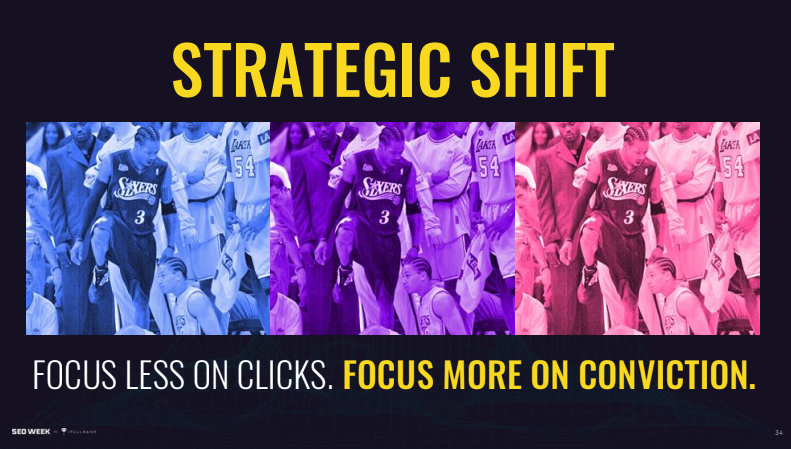
The line: «Stop trying to write the answer. Focus on being the answer.»
Follow the author:
John Shehata
Speaker: John Shehata
Talk: The Truth About Google Discover: What Works, What Doesn’t, and What’s Changing
If there’s one talk from the day the entire publishing industry is going to clip and save, it’s this one. John arrived with data from millions of articles and trillions of impressions and opened with numbers that are hard to believe:
- Google Discover already accounts for 75% of Google traffic, while traditional Search has fallen to 23%.
- Discover’s CTR is six times higher than Search because it’s an immersive feed, with no side distractions and less visual competition.
The catch is that Discover isn’t free and is fully dependent on Search, since to survive in the feed you have to perform well in traditional search first, sustainably, and with high-quality interactions.
It’s a supplementary and volatile channel, not a standalone one. He broke the algorithm down into five phases:
- ingestion and qualification
- classification
- eligibility and matching
- on-device assembly
- delivery and feedback
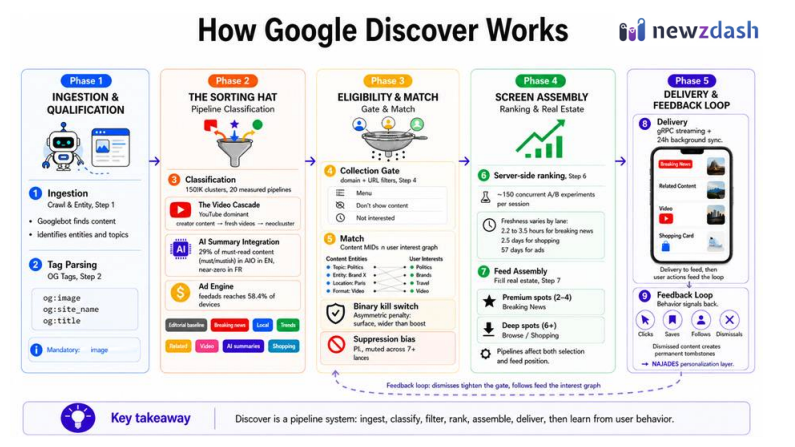
Critical technical filters:
- images at a minimum of 1,200 pixels
- Open Graph tags taken seriously (OG image, OG site name, OG title)
- explicit presence of people, since 28% of successful articles feature a named person in the headline.
On the February 2026 Core Update (Feb 5-27): an 8% drop in unique publishers, clear benefit for local content, listicles heavily punished, and a new «site topic authority» metric that penalizes generalist outlets.
He highlighted that over the past month YouTube has become the number 1 source of visibility on Discover, X (Twitter) lost 88% of its visibility by April 24, 2026 and recovered almost in real time on April 29.
The most profitable practical tactic he left was: write headlines in the first person, 12-15 words long, with an OG title that’s different from the site’s H1.
The line: «Discover is no longer a traffic hack. It’s a quality test dressed up as a feed.»
Follow the author:
Brie Anderson
Speaker: Brie Anderson
Talk: We Had One Job (& It Wasn’t Rankings)
Brie delivered the uncomfortable talk the industry needs to hear from time to time. We’ve spent years selling clients the wrong metric (visibility, traffic, impressions) and now that SERPs are changing and introducing AI, clients get angry even when sales are going up.
The blame isn’t on AI, it’s on us, for having miseducated the market for a decade.
Her thesis is direct: stop selling traffic, start selling business outcomes. And that requires two moves.
- First, sit down with the client or stakeholder and find out their real fears, the year’s investments, pending launches, their goals… SEO success is measured by how it supports those initiatives, not by how many positions you climbed this month on a keyword nobody on the executive committee cares about.
- Second, remember that the scope of SEO work is much broader than what we report, since page speed, information architecture, useful content, digital PR, UX, are all levers that directly impact conversion and revenue.
Standardize UTMs across EVERYTHING (business profiles, review sites, guest posts, newsletters, email signatures), use multi-touch attribution reports in GA4 instead of staring at last click, set up custom funnels to isolate the financial impact of specific elements (a glossary, a reviews section, a comparator) and keep a centralized changelog crossing algorithm updates, PR launches, technical changes and publication dates, so when someone asks «why did this go up?» you can answer in minutes.
The line: «There’s a difference between showing up and giving someone the right information at the right time so they can make the right decision, instead of just showing up to show up.»
Follow the author:
Zach Chahalis
Speaker: Zach Chahalis, iPullRank
Talk: Why You Need A Relevance Engineer Driving The Car
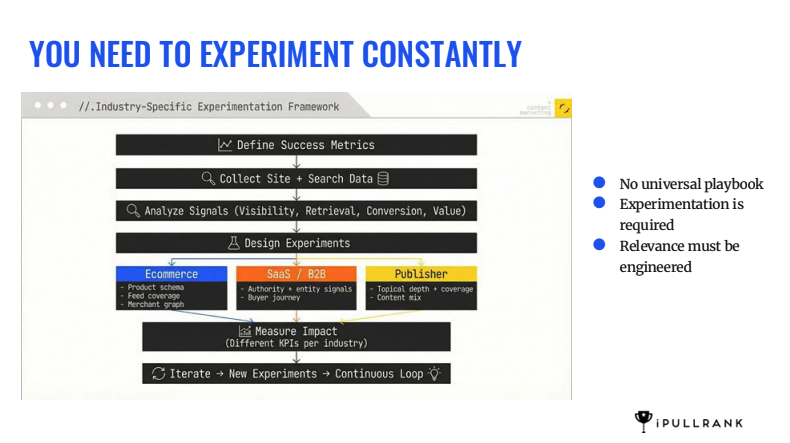
Zach closed the day with the analogy of classic cars, which require a skilled and active driver, not autopilot. The metaphor is meant to talk about the role the industry needs right now, that is, the Relevance Engineer, a figure who combines NLP, technical engineering and content strategy, and who replaces the classic technical SEO as we knew it.
His diagnosis is blunt: measuring rankings and traffic alone is dead. The integration of AI Overviews is already hurting traffic on dominant platforms like Wikipedia, so the new metrics are share of voice, citation rate, sentiment of the mention and real business events.
And to diagnose what’s happening inside each page, iPullRank uses five NLP levers:
- keyword cosine similarity (measures topical coherence and penalizes semantic drift)
- strategic entity richness (useful entities vs filler)
- explanatory efficiency (density of facts vs empty narrative)
- verifiable claims (can they be corroborated by other trusted sources?)
- information gain (does it bring something new or repeat what’s already out there?).
The devastating real case he showed was that of a SaaS company that filled its blog with «AI slop» outside its core topic, that is, auto-generated content with no judgment to inflate volume. The result was a 90% drop in positions since January 2025 and near-total disappearance from AI results. In the same comparison, finance and tutorial sites with high information density and strict topical focus held up without breaking a sweat. AI slop is not a theoretical risk, it’s a sentence.
And one technical detail almost nobody monitors but that matters a lot: HTTP 499 errors (server timeouts when an agent cancels the request) correlate directly with immediate loss of citations on AI platforms and only recover once the technical performance is fixed.
If your server is slow, AI doesn’t even wait.
The line: «Your strategy is only as good as the relevance engineer driving the car. And unlike Tesla’s autopilot, you can’t just turn it on, set it and forget it.»
Follow the author:
Read the SEOWeek Day 1 summary
Read the SEOWeek Day 2 summary
Read the SEOWeek Day 4 summary
Soy MJ Cachón
Consultora SEO desde 2008, directora de la agencia SEO Laika. Volcada en unir el análisis de datos y el SEO estratégico, con business intelligence usando R, Screaming Frog, SISTRIX, Sitebulb y otras fuentes de datos. Mi filosofía: aprender y compartir.